Showing posts with label Recipes. Show all posts

Tuesday, September 23, 2014

A Streamlined New Years - with pudding

We are coming upon the High Holy Days....time to begin our self-reflection as we begin a new year:


This time of year can be fraught with an overwhelming sense of guilt, responsibility, and yes, authenticity. Too often I find this time of year to be filled with a lot of judgement of others and not so much about one's self. And to me, that misses the point. 

There's certainly enough research out there to see that traditions change, morph and sometimes fizzle as we move forward. It doesn't mean it's any less authentic, but rather a statement of how we can best fit important messages into our lives. 

It's like how I feel about fad diets. Why throw out everything you know about eating, when the basics are already there, just maybe ignored? 

So, whether or not you actually do observe this time of year and whether or not you identify with doing anything for it, I thought I'd once again delve into the traditions and see if I can make of them.

After last year's recipe for honey cookies, I decided to stay far away from traditional honey cake as possible. And for some reason, I've been craving pudding. So I went with it. 

This time, the recipe is entirely from the Streamlined Ska Librarian's imagination. I've never made pudding, let alone a rather nontraditional flavor like apple-honey, so there were a lot of experiments and tweaks. And even though I wanted that pudding siliness, I decided it needed some crunch in the end, so I quickly sauteed-carmelized some apple slices for the top. You could go the whipped cream or fruit route, or even chocolate chips. 


And yes, this recipe contains corn starch, honey and dairy products (albeit low-fat milk and skyr), but I also use unsweetened applesauce (nothing but apples!) which doesn't need a huge amount of sweetening as a dessert. And anyway, portions are portions and a sweet Rosh Hashana treat can be just the thing you need to set you on the path for the rest of the year.


The Streamlined Ska Librarian's Rosh Hashana Apple - Honey Pudding (serves 6)

1  cup cornstarch
1 tsp salt
1 TBS cinnamon
1 TBS cardamom
1 tsp ground cloves
1 tsp all spice
2 TBS ground ginger
1 cup water, buttermilk, yogurt or cream (I use Siggi's Filmjölk)
Filmjölk
Filmjölk
siggi's filmjölk
siggi's filmjölk
3 egg yolks
1 qt 2% milk
1 1/2 cups unsweetened applesauce
3/4 cup + 2 TBS honey
1 cup brown sugar
1 TBS vanilla 
1 apple
1 TBS butter
splash mirin (optional) 
extra cinammon, cardamom, etc. to taste

1. Combine cornstarch, salt and spices in a bowl 
2. Add liquid until a well mixed slurry is produced. (Add additional water if needed)
3. Beat the three yolks and add to the cornstarch mixture
4. In a fairly large saucepan, heat the applesauce, 3/4 cup honey and sugar over medium until combined.
5. Add the milk to the applesauce mixture. Heat until it just begins to bubble.
5. Whisking constantly, slowly pour about 3/4 of the milk mixture into the egg-cornstarch slurry. It should be well combined, a bit frothy, but still totally liquid.
6. Pour this mix back into the saucepan and start whisking at a steady pace. In about 2-3 minutes it should start to thicken. 

Just like this...

7. Add vanilla and taste to see if more spices are needed.
8. Keep whisking for about 5-10 minutes until the pudding is smooth and thick. Do NOT let it boil.
9. Remove from the heat and let cool completely. Cover with plastic wrap if you're one of those people to hates pudding skin.
(It may take quite some time to cool. Don't put it in the fridge until it's completely cool).
10. When ready to serve, slice apple and sautee in a pan with butter,  remaining honey and mirin. Add spices when cooked.


11. Let cool slightly and place on top of each serving of pudding.

And the result?


Mmm...mmm! Atonement will be a breeze after this!


L'Shanah Tovah, y'all!

References:


Liu, Joseph. “A Portrait of Jewish Americans.” Pew Research Center’s Religion & Public Life Project, October 1, 2013. http://www.pewforum.org/2013/10/01/jewish-american-beliefs-attitudes-culture-survey/.

Thursday, September 11, 2014

Failing homemakers, or Spice up that Carbonara!


The other day I cooked with goat's milk. It wasn't any definitive recipe or attempt at being more "organic" or "natural" (Goats aren't exactly wandering around downtown Manhattan), but I was in the dairy aisle, it was on sale in half a liter size containers , and I felt like trying it.

The results were tasty, although I can't say for sure goat's milk lent that final piece of specialness. And the results certainly weren't any healthier because a goat was involved.

And then there was this bit of experimentation: Ancho Whole Wheat Carbonara


Mmmm...that's a spicy pasta!

Not as light as my fluffy dinner balls, but a pretty amazing piece of work. In fact, here's the recipe:

The Streamlined Ska Librarian's Ancho Whole Wheat Carbonara
(Serves 2-4, depending on portion needs)

2-3 dried ancho chiles
1 cup boiling water
1/2 pound smoked bacon, chopped into pieces (or other smoked not-too-lean meat)
2 Tbsp olive oil
1 cup corn (fresh or frozen)
1 cup peas (fresh or frozen)
1 cup onion, diced
3 cloves garlic, diced
Apple Cider Vinegar
Chicken Stock
3 eggs
1 cup half & half (or other fatty dairy milk product)
1 cup Asiago cheese, grated
Salt & pepper to taste (depending on meat choices, you may need extra salt).
1/2 lb whole wheat pasta

1. Stem and seed chiles, place in bowl and pour boiling water over to cover. Let steep for at least 15 minutes
2. Puree chiles (with water)  in processor until smooth
3. Sautee the bacon pieces until crispy. Drain on paper towel.
4. In same pan, add olive oil, corn, peas, onion and garlic. Sautee until beginning to brown. Deglaze pan with vinegar and stock. Keep flame on low and stir veggies occasionally.
5. In separate bowl,  beat, eggs, half & half, 1/2 cup cheese and chile puree until mixed.
6. Boil pasta until just al dente.
7. Drain pasta (saving some of the water). Put pasta back in pot. Add veggies, bacon and egg-chile mixture and stir until incorporated. Add a few spoons of pasta water if needed.
8. Top with rest of cheese, pepper and salt, if needed.

(and for dessert, there was goat's milk pudding!)

It's been a while since I've put something like this together on a weeknight. I realize that's one of the possible upsides of my recent cohabitation: I'm willing to cook more elaborately because someone else is doing all the dishes! And this recipe does leave a lot of stuff to be washed.

It is definitely the drudgery of domesticity which can prevent a lot of more "home spun" creations. It's time consuming, it can be economically unfeasible and sometimes just not pleasant.

Which is why I am once again rolling my eyes at Michael Pollan and his call for the "old fashioned" ways. In the past few years, he's been touting that home-cooked meals eaten with the family are what's truly missing from our lives now and blame is placed solely on those modern thinking housewives. (I've ranted about his smug attitude before). 

I love cooking. I even love healthy Streamlined cooking. I love the sense of creating and sharing something out of food, even if it's just for my own gullet. But when I've worked 12 hours and still want to get some stress relieving exercise in the mix and have to clean the house, do homework, and yes, write this blog, well then, I'm not above going the less than "made from scratch" route. Or even a pizza or pannini from down the street.  


A recent study did show that perhaps the decrease in household maintenance has contributed to decrease in energy expenditure which one can try to correlate to an increase in obesity. Although it doesn't really take into account that perhaps energy is being expended elsewhere. 

But is that what we're looking for? Women who do nothing but chop wood, milk cows, mill grain, and start cooking the meal at 5 AM so we can have dinner? I think most modern working mothers (at whom Pollan seems to be aiming) really do not have time for this crap. Even my mother, she of Julia Child influence and natural "treats," didn't always make her own tofu and pickle her own crab-apples from our backyard tree. She had better things to do.

A recent sociology-anthropolgy study on this topic takes Pollan to task:

"While Pollan and others wax nostalgic about a time when people grew their own food and sat around the dinner table eating it, they fail to see all of the invisible labor that goes into planning, making, and coordinating family meals. Cooking is at times joyful, but it is also filled with time pressures, tradeoffs designed to save money, and the burden of pleasing others"

Basically, we have been creating ways to ease the burden of much our worklife, but it's supposedly bad when we then deny this nostalgic view among those who can afford to have said nostalgia. 

Yes, you shouldn't just shovel fast food at the family for dinner all the time. There are studies that show that kids' tastes start early, so healthier dishes and fruits and vegetables thrown in between the mac and cheese dinners might make for better choices as they get older.  

But we're not in Donna Reed land anymore. Even Donna Reed wasn't in that land:

OK, enough award-winning "bad girl" roles, Miss Reed. Those radishes aren't going to rosette themselves!


So, Mr. Pollan, go try working for drudge wages and see if you still want to pluck your own ducks before starting the home made croquembouche. The rest of us have reality to deal with. 

Experiment in the kitchen. Just don't chain yourself to it.


References:

Archer, Edward, Robin P. Shook, Diana M. Thomas, Timothy S. Church, Peter T. Katzmarzyk, James R. Hébert, Kerry L. McIver, Gregory A. Hand, Carl J. Lavie, and Steven N. Blair. “45-Year Trends in Women’s Use of Time and Household Management Energy Expenditure.” PLoS ONE 8, no. 2 (February 20, 2013): e56620. doi:10.1371/journal.pone.0056620.


Bowen, Sarah, Sinikka Elliott, and Joslyn Brenton. “The Joy of Cooking?” Contexts 13, no. 3 (August 1, 2014): 20–25. doi:10.1177/1536504214545755.


Louis, Catherine Saint. “Childhood Diet Habits Set in Infancy, Studies Suggest.” The New York Times, September 2, 2014. http://www.nytimes.com/2014/09/02/health/childhood-diet-habits-set-in-infancy-studies-suggest.html.

Thursday, August 7, 2014

Happy fluffy dinner balls

[No references, just a recipe]

It's just been a wacky week. Along with gout recovery, we're finally getting repairs done on the apartment. Repairs that were needed from Superstorm Sandy. And of course, some of the "simpler" fixes have turned into multi-day event dramas:


I just wanna take a shower!
So between work obligations, dealing with maintenance men and having newish pets still acclimating to each other (and said maintenance men), all of a sudden it's 6 PM and dinner has to be on the table. 

What's a streamlined ska librarian to do?

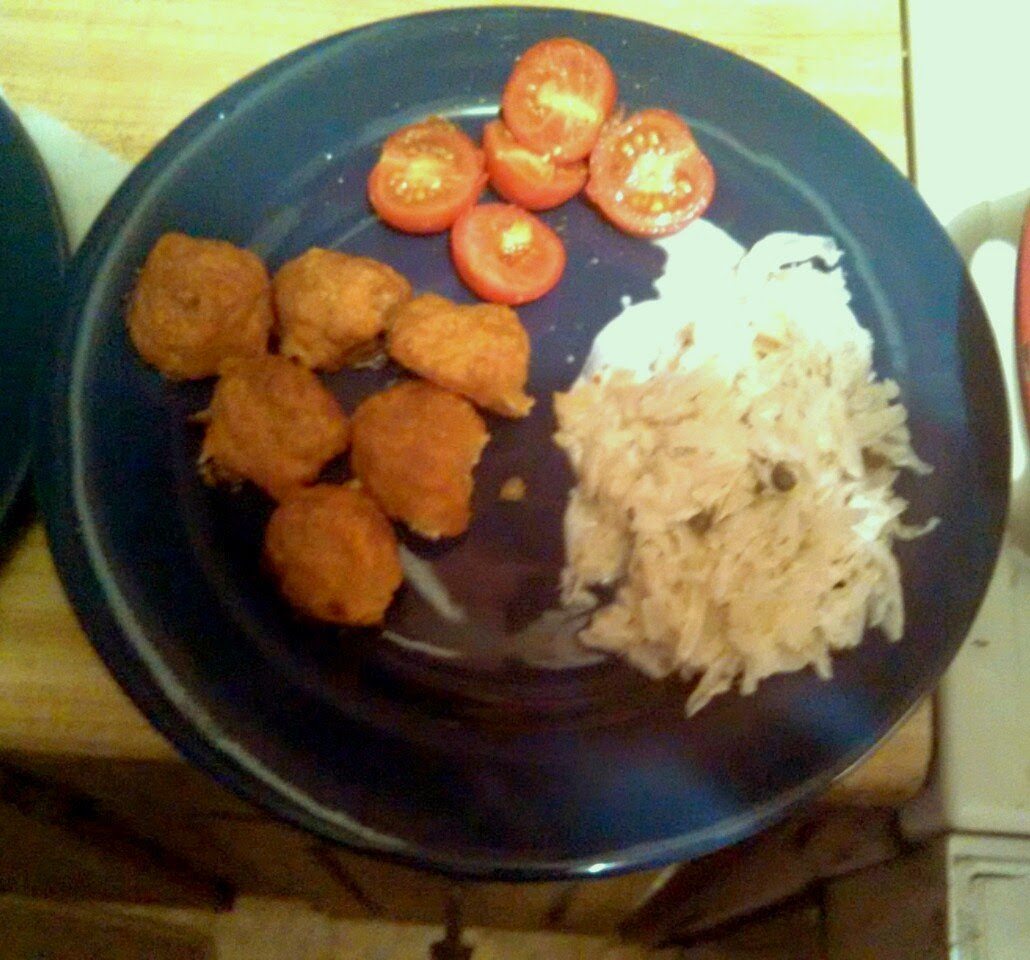
Thankfully we had some ground turkey, and meatballs are usually quick, but I wanted to kick them up a bit and still keep them healthy. I had some yams, egg whites and tons of spices. And then I added a little molasses for contrast and taste and also to help create some caramelization. They were very light and barely solid, but I didn't want to go the flour route, so I threw in a little corn meal.

The result?


Not the best photo but I'll leave that to the "foodies"
They were amazingly fluffy and wonderfully fragrant with just the right molasses crust on the bottom. Paired with a little sauerkraut cooked in a sherry-sour cream sauce and fresh tomatoes with zataar....perfection after a stressful day!


The Streamlined Ska Librarian's Fluffy Spicy Meatballs
(Serves 4-6)


1 lb. ground turkey
3 TBS. Tandoori spice blend (I buy mine from my local fave, Dual Specialty Store.)
2 tsps. minced garlic
1 TBS. dried ginger
2 TBS. molasses
2 egg whites
1 1/2 cups cooked sweet potato or yam
1/2 cup corn meal

1. Preheat oven to 350F
2. In large bowl, combine all ingredients until well blended
3. Form into balls about 1 1/2 to 2 in in diameter
4. Place on oiled baking pan
5. Bake until done (about 30-45 min.)


Sunday, June 1, 2014

That diet is bananas!

First, if I may:


LET'S GO RANGERS!!!!! WHOOOP!! WE WANT THE CUP! 

OK, now where were we...

A browse through some of my recent cookbooks acquisitions brought this little ditty to light:


via The Buffet Cookbook
 
This is not something met with my usual lip smacking culinary fantasy. However, it seems this was a fairly common recipe in mid-century cookbooks. And I was intrigued. Instead of getting immediately creative, I followed the recipe pretty much to the letter (except I halved it). The result?


Ummmm...no. Granted, my dinner guest thought it was delicious. I thought it tasted like, well, bananas mashed into beef. Blerk.

This might have been good with some sort of curry or jerk spice. Something tangy-spicy to interact with the bananas.

To me, it was a failure. Even if the blog reviews of this recipe were saying it was amazing.You can't believe everything you read.

Which is why this particular article in the NY Times made me a little nervous, at least by it's headline. Men losing 11 pounds in only 4 days? If you look at the full study, overweight men were given severe caloric restriction (360 cal/day!) combined with intense exercise, then continuing increase exercise for another week. And surprise, these men lost a lot weight. And they seemed to have kept it off after a year. But even the scientists confirmed that this needs more observation and it may not be ideal for those without the initiative.
But also, there was a only a handful of men in the study, so this cannot be considered a universal solution, just yet.

Also, looking at it in perspective, when I started my Streamlined lifestyle change, I worked out with my first trainer that if I cut my intake to 2700 cal/day, but increased my exercise, I could maintain my goal of a one lb. of weight loss per week.

Now that was already a huge calorie drop for me. Doing a quick and dirty calorie count on Retro Ska Librarian meals, I was probably taking in 4000-6000 cal/day. Way more than any recommended daily allowance. So coming down to 2700 was already a shift, never mind that it also meant I should be engaging in "intensive exercise" at least 5 days a week (otherwise weight loss would have been only do to even less calories).  I cannot imagine handling 360 cal/day. That's not even a bagel or a beer.

So while this is an eyebrow raising study, do we see it fitting into a healthy lifestyle change? I'm sure someone will try to bank on that! 

"The Danish Starvation Diet! Eat like a Little Mermaid!"

But what makes it more difficult could be our overall diet. A brief written for JAMA has two doctors saying it is the way we store fuel in fat cells that can actually prevent us form properly losing weight. Coming back to the theory that it's not how much you eat, but what you eat. 

I'm not sure how I feel about this theory, and it is just that at the moment, a theory. Taken at it's basics, yes, it is healthier when you count calories to try to eat healthier foods (I suppose 2700 cal/day of frosting tubs would have not have been very smart of me to do).

But will this idea throw more people into the arms of "quick fix" diets and pills, as they feel they are "doomed" by their fat cells? Frank Bruni, fellow former pudgy guy, does see it as a problem that we all fall into:

"And the vogue for painstakingly tailored eating regimens and dieting techniques is to some extent a distraction from that, a dangerous one, because it promotes the idea that basic nature and fundamental biology can somehow be gamed, cheated, transcended."


There is no cheat. There is no extreme way of doing this. And I can no longer buy into any special diet.

It is highly possible that my fat cells have been so overworked that weight loss for me might be harder. But I did do it, without denying myself anything out of the ordinary. However, maybe those "trigger" foods are what these doctors are talking about.  I don't know, I just know what worked and it wasn't advertised on TV.

In any case, there is no easy answer. Never was. Never will be. You want a miracle, look at those beautiful NY Rangers! It took 20 years, but they finally hit their goal! (OK, ouch...)

 
References:


4 Days, 11 Pounds. (n.d.). Well. Retrieved May 23, 2014, from http://well.blogs.nytimes.com/2014/05/22/4-days-11-pounds/


Bruni, Frank. “Diet Lures and Diet Lies.” The New York Times, May 26, 2014. http://www.nytimes.com/2014/05/27/opinion/bruni-diet-lures-and-diet-lies.html.


Calbet, J. a. L., Ponce-González, J. G., Pérez-Suárez, I., de la Calle Herrero, J., & Holmberg, H.-C. (2014). A time-efficient reduction of fat mass in 4 days with exercise and caloric restriction. Scandinavian Journal of Medicine & Science in Sports, n/a–n/a. doi:10.1111/sms.12194

Ludwig DS, & Friedman MI. (2014). Increasing adiposity: Consequence or cause of overeating? JAMA. doi:10.1001/jama.2014.4133

Monday, May 12, 2014

Knowing and "No"ing

This was making the rounds recently, from Jimmy Kimmel:


Not too surprising. I'm a little more surprised by the comments on some sites that linked to this, somehow blaming the restaurants for not really handling gluten free food properly for those who have celiac disease and THAT'S why these answers are ignorant.

Wait...what?

This video shows that people are denying themselves gluten WITHOUT EVEN KNOWING WHY! Why are you blaming restaurants for something you don't even know why you're avoiding?

I'm sure this was staged in some way, but I certainly hear this enough from folks when they approach me to ask my opinion of trying a diet, as the Streamlined Ska Librarian lifestyle is so successful ... for Streamlined Ska Librarians.

Yes, as I've said many times, what worked for me was portion control and an increase in exercise. For me. And having tried "specialized" diets in the past, I know that any sort of real restriction, especially for those of us with binge issues, does not work in the long run. But many people, like those in the video, want to hear that eating "special" is THE answer.

But I also notice in these all new gluten-free/paleo/artisinal-crafted diets that they forget one main thing: our portions have gotten a LOT bigger in the past several decades.

I'm not even going to reference one scholarly article. There have been so many written lately. Soooo many.

And basically they all show that increased portions increase our energy intake AND that portions have gotten bigger in general.

So it's not that you're eating no gluten. You're still increasing the amount of other food you are eating. And a lot of these "faux foods" actually have more sugar, so...

Let's take a look back at some vintage cookery. We often get unneeded/unwanted donations in the Library or we are looking to de-accession older, damaged copies. So when old cookbooks come in, they often are sent to me to covet, pick through and invoke Head Librarian privilege.

"Mine! Stay away! Hissss!"

And while there are some truly questionable recipes in some of them, I do love perusing them. Look at this lovely setting from the Betty Crocker's Picture Cookbook section on salads:


I'm not sure what kind of salad they're making, but it certainly got Grandpa and Grandma all excited! Get a room, you two!

Now some of these salads, many of which include canned fruit, gelatin and/or mayonnaise, would not normally make it to my table, nor might they induce  friskiness as I approach AARP levels. But I can't help but notice that most of these salads say they "serve 6" even though they include a much smaller amount of ingredients than similar salads found on culinary websites today. So you can dress up your salad with Princess Mayonnaise (1/2 cup mayo, 1 tbsp maraschino syrup, 4 chopped maraschino cherries and 1/4 cup cream, which equals about 2.5 TEASPOONS per person) and not deny yourself a serving of Baked Prune Whip for dessert (I'll only share that recipe if asked).

One of the other books I took home was the Larousse Gastronomique, which is more than just recipes. It's an encyclopedia of historic food in France. It's filled with descriptions of ancient herbs, spices and cooking methods, as well as citations of various foods in French literature. (The Balzac marzipan story is fascinating.)

It also references foods, like otter, which "have a horrible taste." I like that sense of completion.

By including all sorts of foods, even those not considered edible, the book shows that you can extend your food choices to everything. It's the exact opposite of what we see today. The readers of this cookbook avoided foods in  that were considered poisonous or bad tasting. Otherwise, it was fair game to experiment. 

Nowadays should we look at the dozens of pages of garnish recipes and avoid them because they might contain gluten? Also, very few of the recipes give the amount of people they were meant to serve as it's assumed you wouldn't eat an entire plate of Double D'Agneau on your own. 

So if you really want to have a Streamlined Ska Librarian body ... tough, it's mine. But don't deny yourself soemthing unless you KNOW why you're doing it.

OK, I'm going to go try some Otter a la Princess.


References:


Crocker, Betty. Betty Crocker’s Picture Cook Book. New York; London, 1950.

Montagné, Prosper, Charlotte Turgeon, and Nina Froud. Larousse Gastronomique: The Encyclopedia of Food, Wine & Cookery. New York: Crown Publishers, 1961.


Monday, January 27, 2014

A Catalog of Cooking, or Streamlined eating in the Library

A page from Teen Cuisine, illustrated by Peter Max.

Yes, that's a page from one of the hundreds of cookbooks in my personal collection (although I did not take this photo). I can't say I find a late 60's teen party cookbook too Streamlined inspiring but man, the overall design makes it a great addition to any dinner party, room or rap session.

Yes, I've mentioned before about collecting cookbooks, some for their historic entertainment and others for actual cooking. And I do scour the web for inspiration. But I would be remiss in both my Retro and Streamlined Ska Librarian physiques to not talk about some great resources for recipes and menu planning available from libraries. 

Some resources are a little more esoteric, such as New York Public Library's great menu collection, for which you can help add metadata. (Crowdsource Delmonicos!)

But there's also a new beta site that I'd like to share: The OCLC Worldcat Cookbook Finder. 

Worldcat is a website that links up to thousands of library catalogs all over the world. It's a nice way to find out if a book is available in your area or if you can get it through inter-library loan.

The Cookbook Finder can be  searched by the usual terms, but also by ingredient, method and (be still my heart) Dewey Decimal Number. 

[I find those librarians that poo-poo DDC in favor of some more "popular" classification systems to be just missing out.But that another post for another time.]

And let's be honest; much as I love owning cookbooks, price and space does not always allow that personal library to grow. Thankfully, cookbooks are a big part of library collections. What if I really wanted to try some new eating plan and perusing the web just wasn't doing it, as it was too disparate and not easily self-contained? This, my friends, is the way to go.

So, I'm going to recommend a few items that have inspired me in my Streamlined Ska Librarian lifestyle. And by "inspired" I mean I enjoyed these ideas for recipes and promptly saw how I could fit them to my own style, technique and need. These are all from my own collection, but are also available in libraries. The following links are to the Worldcat pages.


The Gefilte Variations by Jayne Cohen.

This has some really nice variations of traditional Jewish foods (and the author's a librarian!) but oy gevalt! These recipes take time and equipment! Certainly not something always easy in a small NYC kitchen. The ingredients are simple (for example, the amazing potato-onion kugel is just potatoes, onions, oil, eggs, rosemary and salt) but they often require several pots, multiple preps stages and a LOT of space! Still, these are easily tweakable to inspire your own variations, with or without gefilte. 

Het grote kookboek : een culinaire ontdekkingsreis door meer dan 800 recepten

I know we often make fun of British food, but having worked with the Dutch for so long, those Brits ain't got nothing on bad food reps! Still, in order to better appreciate "echte Nederlandse keuken" (and help me get a better grip on the Dutch language), this book has come in handy. And while not all the ingredients are the same across the pond, it's nice to know it's not all bitterballen and stoempf. In fact, some of it is downright healthy! (gestoomde zalm met asperges, anyone?)

Crumbles & Tatins by Aude de Galard and Leslie Gogois.

I picked this book up in a Paris bookshop some years back. This is a perfect example of French food that is not overly fancy or very difficult to make. In fact, the recipes are remarkably simple. And they run the gamut of taste from those of us who like boudin noir to the more healthy variations of vegetables. However, it does use butter because, well, it is France. But you can still tweak it to make it to your liking and needs. 

Floyd on Britain & Ireland by Keith Floyd. 

What was I saying about the Brits? Well, there's also Keith Floyd. Before all the new, hip cuisine of Great Britain, there was this fabulous rather inebriated fellow who would appear on television and who knew how to cook. Again, the ingredients may not always match up to US products, but you can easily Americanize your groats and potted shrimp. What I do like about it is that these are recipes to really "get your hands dirty" using all partsof plants and animals. 

So, go browse, borrow and cook!


Monday, November 25, 2013

Countdown to eating a lot, part 4: Sufganiyot Ice Cream

Well, I did say it was ice cream time.

My Streamlined Ska Librarian lifestyle usually means I'm not making a lot of ice cream as of late. An occasional sorbet, perhaps, but now I now save the ol' ice cream maker for the holiday season, or to make a tasty gift.

And I figure with maybe 15 people showing up, it's not like there will be double portions for me.

Some past holiday ice creams reflect the season (pumpkin, maple, cardamom), but this time I wanted to make something that reflected the Thankgivingukah season.

One of the few Chanukah type desserts are sufganiyot, or jelly donuts. Not a big fan and certainly not looking to fry up a bunch of doughy things.

But my faithful ice cream maker comes to rescue. I'm already making an assortment of pies, so why not a sufganiyot ice cream?

And here it is!


I made it very vanilla-like with orange hints, which gives it that cakey taste. As for the jam, I used blackberry preserves:


But any jam/jelly would do.


The Streamlined Ska Librarian's Sufganiyot Ice Cream (or Jelly Doughnut Ice Cream):

1 cup sugar
1 cup orange juice
2 tbps orange peel
1 tsp cinnamon
2 tbps vanilla
1 1/2 cups heavy cream
1 1/2 cups half and half
2 egg yolks, beaten
jam of choice

In a double boiler, combine sugar, juice, peels and cinnamon and heat until combined. 
Add cream and half-and-half and cook until slightly thickened. 
Add vanilla. Cook until heated.
Take small amount of cream mixture and blend into the egg yolks until thoroughly mixed. Stir into cream.
Cook until thickened enough to coat a spoon.
Cool and chill in refrigerator (preferably overnight).
Place mixture in ice cream maker. When it's almost set, add a few spoonfuls of jam and let mix in.
Remove ice cream from machine. Add another spoonful of jam for good measure.
Set in freezer until dessert time!

I realize this is probably the most unhealthy item you'll ever see on this blog, but mindfully eating something once a year is, for me, ok. I know this will NOT be a nightly snack.


Enjoy!


Sunday, November 24, 2013

Countdown to eating a lot, part 3: Cranberries!

And we're back to recipes! I just finished completing my Thanksgivingukah shopping list and here's the tentative menu:

Turkey a la Dan
Kielbosa-apple stuffing
Potato-onion kugel
Baked marinated tofu with 2 sauces (tomato-olive and chimichurri)
Kasha Varnishkes with onion-mushroom marmalade
Zucchini "pudding"
"2 Fat Ladies" Parsnip puree
Curried brussel sprouts
Sweet and sour cabbage
Creamed onions with bacon
Sweet potato corn bread
Cranberry-ginger compote
Buttermilk pies (one with fruit, one without)
Pear-cranberry pie
Pumpkin pie
Apple Pie Ice Cream
"Sufganiyot" Ice Cream (Basically a jelly donut ice cream)
Date-pistachio balls

Meat, vegetarian, kosher, trayf...it's got it all! You can see one of the experiments earlier this month is on the menu, while the other got cut out of the final list. So it goes...

But I do say this is "tentative" in that sometimes recipes get tweaked at the last minute. And sometimes there have been a few accidents. (The "spilled salt" incident totally killed one of these last year!)

Some of these are based on recipes found in cookbooks, but most have been tweaked by me. The exception is the 2 Fat Ladies dish. Such a decadent artery clogger....my regular Thanksgiving guests insist I make it the "traditional way" every year.

And the first thing I always cook is the cranberry compote. I love cranberries. I stock up on them, toss them in my freezer and use them throughout the year. 


My freezer before I went shopping!


 I love that cranberries freeze easy. I also love that most cranberries are fine to buy. No real brand preference for me. Or the excuse to try to be artisinal:


Do you hipsters honestly think Whole Foods just didn't dump a couple of bags into this water? Sheesh!

Ah, that makes me laugh every time I see it. 

But here we go with my happy, non-artisinal dish:

The Streamlined Ska Librarian's Cranberry-Ginger Compote

There are actually only three ingredients (plus one optional):


1 bag cranberries
maple syrup
fresh ginger (a large piece)
Optional booze of choice (this time we're using a Ginepro grappa, a gift from my hosts during my French vacation, although bourbon, rye and even tequila have been used in the past).

Rinse cranberries and pick out any bad ones.

Place in pot with enough maple syrup to cover


Cook over medium-low heat until simmering. 

Peel and cut ginger into small pieces and add to pot. Stir as needed.
(You can also squeeze the ginger juice directly in)  

As it thickens, you can, if you wish, add a few good splashes of the liquor.


Continue cooking down until it forms a thickened mixture:


Let cool and place in covered container. It can be refrigerated for several days (which is why I make it first!)

The tartness of the cranberry and the bite of the ginger work well with the earthy sweetness of maple syrup. And the grappa gives it a nice herbal finish. This also works well as an ice cream topping. 

Now we're on to ice cream making!


Sunday, November 10, 2013

Countown to eating part a lot, part 2: Did you say radish? And Campari?

When I cam back from my time in Japan, I was more than happy to continue the Thanksgiving tradition at Chez Ska Librarian (still Retro in those days). But I had picked up a few tricks of the trade in Tokyo and wanted to fit those into the meal.

OK, so not really tricks. More like me doing my usual recipe tweaking much to the horror of my Japanese acquaintances. I always joked (joked, it's all in fun!) that the official motto of Japan should be "No substitutions on the menu." And that's basically a direct challenge for me!

One of the very ubiquitous (and one of the the few inexpensive) items one found at Japanese markets was the daikon radish:


You can buy one in Japan the size of an entire arm for about 2 bucks!
Daikons are usually used as a garnish or soup addition, just grated straight into the bowl. They taste...well, like radishes.

But I soon discovered another way to use this root. If you simmer or poach them in water or broth until soft, they become these sweet, soft, delicate pucks of tastiness. More mellow than a turnip. 

In Japan, it's a basic boil and then served with white miso. But after one or two tries like that, I began to wonder just how it would work with other flavors. I often poach chicken in vermouth, so why not these? They were deLISHous! So I added olives soaked in gin and made Martini Daikons. 

It was a fun idea, and I certainly have enough martini-loving pals, even if I don't drink them anymore. But I wanted to see if something else could be done with these big fellas. Something more festive that might work spice-wise for both Thanksgiving and Chanukah, yet also appeal to the non-meat eaters attending.

And I spied this in my kitchen:


Hmmm.....I know Campari is an acquired taste, but if your guests don't mind complex tartness, this is for you!

So I now present:

The Streamlined Ska Librarian's Campari Daikons

Wash, peel and slice the daikon into 1 inch discs. Score one side of them. 


In Japan, you're also supposed to bevel the edges. But shape however you like. Make them into Magen Davids. Or Turkeys!
Place daikon slices into large saucepan with enough liquid to cover. This one is:
1 part Campari
2 parts water
1 cinnamon stick


Bring to a simmer and cook until fork tender (about 25-30 minutes). Remove from liquid and let stand until room temperature. (You can also refrigerate them for a few days and bring back to room temp before serving).

And here we are:


Do these not look lovely? They're actually a little pinker than this photo. 

The sweetness of the cooked daikon with the spiciness of the Campari and cinnamon. Mmm...
These were eaten with some salty-savory snacks and the play of flavors was great.

Will this recipe make it to the Holiday(s) table? We'll see!

Thursday, November 7, 2013

Countdown to eating a lot

Oh, where to begin? So many weight loss and weight maintenance studies our there. And yet, a recent study shows that a large percentage of research on obesity and nutrition tend to overstate their results. Is this really a surprise? I also think the topic lends itself to that. We like to grab onto a definitive "solution" or "answer" when it comes to obesity and nutrition. I know I've certainly been guilty of cherry-picking data I need to make a point. But then again, I'm just blogging here, not claiming I've done grant-funded research. 

I do recommend you seek out the entire article. But that's not where we're going now....

I'm going to take a break from some of the usual format this month and go for a theme. We're coming up on one of my favorite holidays, Thanksgiving. For almost every T-day for the past 22 years, I've hosted anywhere from 3 to 30 people for the feast. Over the years, I've gotten intoa "zone" where I cook EVERYTHING, down to making ice cream for the pies. All guests just bring drinks, themselves and an appetite. It's worked out very well. 

I have some standard favorite dishes (there are a few I've been told can never leave the menu), but it also gives me a chance to try some new things each year. Very rarely is there a true cock-up (more often the casualties are dropped dishes). And I actually find it very enjoyable to just prepare and cook up a storm for a week. 

This year, however, we have a slightly different agenda. Thanksgiving falls on the first night of Chanukah. Yes, the All-American holiday where we all gather together to give thanks and eat a lot of food we may avoid most of the year is now being mixed up with a Jewish holiday where ... we all gather together to give thanks for being alive and eating a lot of food we may avoid most of the year.

Hmmm...this shouldn't be too hard.

Except when you're a kid and you probably feel more left out when everyone around gets Xmas presents, Chanukah doesn't play a big role in many adult Jews lives (or Adult Jews with no kids, I should say). 

Yes, it commemorates, as do many Jewish Holidays, our survival at almost being wiped out, and, like most Jewish holidays, it involved a lot of fried food. And I don't want to be frying latkes just as we're all sitting down to turkey.

So how to combine these two holidays into one super food day?

The rest of this month, I'll be trying out a few recipes and sharing them online. As you know, it's hard for me to actually write down amounts, but I will do my best to ensure you can all share in this. Yes, yes, I am very magnanimous that way.

One of the things I often skip or avoid is a bread with Thanksgiving dinner. In the past there's been pumpkin biscuits, a basic wheat loaf, polentas "crackers" but most often I buy a baguette or two. But I've been toying with a cornbread idea. It's quick, easy and goes well with the all those fall foods. 

But how to make it Chanukah-like? I've seen a few pumpkin or sweet potato corn breads. And a traditional Jewish dish is tzimmes. My family made it with carrots, but I had some yams, which is also "traditional." So why not make a Tzimmes Cornbread? Hmmmm...

I used yams and prunes. I think carrots may be added next time, but yams were a nice thought because you can microwave them very fast. And I thought using coconut oil added another "fruit" flavor to it. I also tend to favor my cornbread more on the corn side with less flour. I actually dropped the flour on the floor (see? that's my thing!) and after that clean-up, I substituted chickpea flour. The end result was good but I think whole wheat flour would work a little better, giving it a little less density. 

I decided to spice it with middle eastern spices and spiked the prunes. The result:


It was fragrant, sweet yet not too much (which is sort on un-tzimmes like) but a nice amalgam of holidays!
This could be good with gravy or applesauce and sour cream! Or even with peanut butter as a snack.


Will it make it to the holiday table in a few weeks? We shall see...


The Streamlined Ska Librarian's "Tzimmes" Cornbread:
 

12 prunes, cut up
1/4 cup bourbon or rye
1 1/2 cup cornmeal
1/2 cup wheat flour
1 tsp baking powder
2 tsps ras al hanout
1/4 tsp dried mint
salt to taste 
2 egg whites 
3 tbps coconut oil
1 to 1 1/2 cups yams, cooked 
1/4 cup yogurt, sour cream or buttermilk
1/2 cup honey
1 tbsp apple cider vinegar 

1. Preheat oven to 350
2. Soak the prunes in the bourbon
3. Combine next 5 ingredients
4. Add next 5 and mix well
5. Stir in prunes and bourbon. Adjust seasoning
6. Bake for 30 minutes or until done. 


References


Menachemi, Nir, Gabriel Tajeu, Bisakha Sen, Alva O. Ferdinand, Chelsea Singleton, Janice Utley, Olivia Affuso, and David B. Allison. “Overstatement of Results in the Nutrition and Obesity Peer-Reviewed Literature.” American Journal of Preventive Medicine 45, no. 5 (November 2013): 615–621. doi:10.1016/j.amepre.2013.06.019.