Showing posts with label Diets. Show all posts

Friday, April 10, 2015

If I Put "Babe" in My Name....

Would that get me better hits on this site?

Maybe I should just blog more! 

Welcome back! It's been quite a few months. There's been some major PT for my leg which means less streamline lifestyle for now. But I'm trying to focus on the positive. I'm learning Danish. And I can only imagine it will be very helpful when I tell Danish librarians, "I er ikke mine rigtige forældre! Hvorfor er min haj i ændernes svømmebassin?" (Yes, those are sentences from my lessons.)

This is a short entry, but I thought I'd chime in because we're finally seeing some true social media backlash on a lot of the crap I've written about in the past. And now it's centered squarely on the Food Babe.

Aside from the latest piece which was shared worldwide, it's not like people haven't already been criticizing her in the media and on campuses.

And it's been fun to see. In fact, go check out #foodbabefacts on twitter.


I'm not saying you can't be skeptical about what might be in food, but please...I say this as a librarian....DO SOME PROPER RESEARCH!!!!!!!!!!

I'm flabbergasted that we allow such inanity in our discourse about health and wellness. You know, Food Babe, there's been quite a lot of research out there on health literacy. It's been a concern for decades. It's not about scaring folks into believing we're all being poisoned. It's about learning to handle information to turn it into proper knowledge. 

I would suggest you might visit your local library soon. You might actually learn something. 

Share information, everyone. Just do it wisely. 


The Streamlined Ska Librarian Babe. (Now I just need my own army...)


References:


“Food Babe Visits My University | Illumination.” Accessed April 10, 2015. http://kfolta.blogspot.com/2014/10/food-babe-visits-my-university.html.

“Is The Food Babe A Fearmonger? Scientists Are Speaking Out : The Salt : NPR.” Accessed April 10, 2015. http://www.npr.org/blogs/thesalt/2014/12/04/364745790/food-babe-or-fear-babe-as-activist-s-profile-grows-so-do-her-critics.

“The ‘Food Babe’ Blogger Is Full of Shit.” Accessed April 10, 2015. http://gawker.com/the-food-babe-blogger-is-full-of-shit-1694902226.

Nutbeam, Don. Health literacy as a public health goal: a challenge for contemporary health education and communication strategies into the 21st century Health Promot. Int. (2000) 15 (3): 259-267 doi:10.1093/heapro/15.3.259 


Sunday, November 16, 2014

Cheesy Diets and Sweet "Life" Choices

My annual physical used to be a non-event; check the BP and cholesterol, be appraised of how healthy I am now, talk about what may lie ahead...nothing special. But as I get older, it seems my body has begun to develop other issues...those along the "oh, you're just getting older" meme.

But these changes may have led to one mystery, that of my new gouty condition. My uric acid levels are way up (gout cause!), but it seems my Vitamin D levels are now really low, as well.

My doctor was not happy.

Hashing this out with my doctor, we realized that I have been getting mega dairy cravings for the past few months, something I never really had before. I mean, I am a fan of a piece of cheese & some fruit for dessert, but looking back on recent times, I've been scarfing large amounts of cheese, keffir, skyr, sour cream, Mexican crema, ice cream, puddings...you get the idea.

And it turns out that excessive dairy products can increase the uric acid in your system which can lead to gout episodes. Which means my lack of Vitamin D meant more intake of Vitamin D rich foods which led to an increase in gout prone blood.

So have we found the culprit?
 
© Evan Dorkin

It's a good possibility, although there has been some research that a uric acid increase in and of itself may be responsible for Vitamin D deficiency among gout sufferers.

Which means my new found dairy addiction is purely based on my own shortcomings. Or getting unhealthy uric acid levels THEN led to dairy cravings, which is sad. Or maybe gout was just a bad timing sort of thing as I get older. (Age is also a common factor for Vitamin D decrease in the body, too).

So now I'm on Vitamin D supplements AND uric acid reducing drugs. Probably on both until...well, until forever. This sort of lifestyle change will get me so ready for my 50th year in 2015 (helped along by the referral the doctor gave me for my first colonoscopy. Yay!)

But I also look at this as another way of seeing that even "healthier" foods do not necessarily mean health.  Perhaps eating goat brie and yogurt is better than boxes of fudge, but it still comes down to portion control and sensible ways of eating. Thanks god I stayed away from the "fat free" cheeses, with all the added sugars and fillers.

Which brings me to my next rant. Chronic gout has meant my running activities have been way curtailed. This weekend, I finally managed to go out for a chilly 5K run, which felt great. But I came across a billboard for a product I hadn't heard of before this week: Coke Life.

via 
I guess it's been on the shelves for a bit, but I don't tend to wander the soda aisles as of late. What gets me is that they're marketing this as a healthy drink and putting "cane sugar" in the same phrase as stevia, showing them both as natural, healthy ingredients.

OK, they both come from plants but "cane sugar" is SUGAR! YOU'RE DRINKING SUGAR! It is a processed product that isn't good for you in excessive amount! Is it healthier than high fructose corn syrup (which, technically, also comes from "natural ingredients")? Perhaps, but you're still drinking sugar water. You might as well just drink Coke non-Life (I won't even touch that one.)

Why do we continue to fall for this crap and why do they still try to push this on us like this? And in what world is sugar a "green" choice? If my toe wasn't all gouty, I'd get up and write an old man letter of complaint to the company.

But for now I'm just gonna cut back on the dairy. Because it's bad enough being grumpy from idiotic health marketing. Not being able to exercise or walk as I get older isn't gonna diffuse that grumpiness.

Who wants to buy some cheese?

References:

Takahashi, Sumio, Tetsuya Yamamoto, Yuji Moriwaki, Zenta Tsutsumi, Jun-ichi Yamakita, and Kazuya Higashino. “Decreased Serum Concentrations of 1,25(OH)2-Vitamin D3 in Patients with Gout.” In Purine and Pyrimidine Metabolism in Man IX, edited by Andrea Griesmacher, Mathias M. Müller, and Peter Chiba, 57–60. Advances in Experimental Medicine and Biology 431. Springer US, 1998. http://link.springer.com/chapter/10.1007/978-1-4615-5381-6_11.

Sunday, September 14, 2014

Like broccoli in a brownie

One of the research links in the previous post addressed how one's tastes are more or less set at a young age. Which may account for my less than favorable opinions of peas.
Stupid peas...think they're so special!
 
It's funny, because I do love pea soup, I adore sauteed pea greens, and I don't mind throwing a handful of peas into a dish for some crunch or color (such as last week's Ancho Carbonara). But a serving of peas with a meal? Meh. I'd rather not.

But I know why this is. Peas were the one ubiquitous vegetable at dinner when I was growing up. We always had other veggies, too, but my dad insisted on peas, almost every night. And unlike much of my parent's other food "experiments" with recipes doomed to scare small children, peas were always served as is: defrosted from a bag and then put on our plates. 

This may speak more to the fact that my mom probably didn't care too much about them and my dad only wanted them as is. They weren't presented as tasty. Merely mandatory. 

And even though I was a surprisingly picky eater, I did scarf down other vegetables. Brussel sprouts, broccoli, spinach, carrots ... yes, please. But peas...I'd hide them in my napkin.

So it should not be surprising that, as an adult, I rarely if ever have peas in the house, nor do I go out of my way to order them in restaurants. It's not like I hate them. They just don't come up in my list of foods to think about. 

Sorry, peas.

Around the same time as my napkin hiding escapades, came a product that was supposed to handle such an issue: I Hate Peas.

These were basically vegetables reconstituted with potatoes (and other ingredients) to make french fries.  And they came in other vegetable flavors, too.

Via

(I had hoped to find the TV Commercial online, but no dice.)  


Even back then, I thought this was a bad idea. Really? French fries as a substitute for everything? 

Now I can really see that my parent's feeding habits of us kids helped me be open to trying most everything. That is especially apparent watching some adult friends and acquaintances who avoid certain groups of foods altogether. It's one thing to not like a a particular food's taste or texture (I was married to someone who hated the pulp of tomatoes. I'm currently dating someone who does not like the taste of cucumbers. We manage.) It's entirely something else to meet folks into their 30s and 40s who won't eat any vegetables or fresh fruit because they find them all "icky".

And I believe these were the people who were probably snuck their "healthy" foods into their "regular" meals. And that's not so unique. You can find tons of blogs about it, so much so that other bloggers have complained about it. (In-fighting among the foodies!)

Even scientific studies have shown that both scientists and moms felt that "stealth veggie-ing" was the effective way to introduce healthy energy-dense food to youngsters.      

But then we end up with folks who only eat deep fried greens and perpetuate this madness by following Jerry Seinfeld's wife into hiding broccoli in your cupcakes.

So, much as I don't often say it...thanks, Mom and Dad, for serving me those awful peas every meal, along with the strangely crisp eggplants, the home made sushi and "crepe night." Without all that, we wouldn't have the Streamlined Ska Librarian recipes we see today.

Stupid peas....


References:


Caton, Samantha J., Sara M. Ahern, and Marion M. Hetherington. “Vegetables by Stealth. An Exploratory Study Investigating the Introduction of Vegetables in the Weaning Period.” Appetite, Feeding infants and young children: guidelines, research and practice, 57, no. 3 (December 2011): 816–25. doi:10.1016/j.appet.2011.05.319.

“Dear Ninja Vegetable Mom: You’re Raising Kids Wrong.” Accessed September 14, 2014. http://www.foodretro.com/dear-ninja-vegetable-mom-youre-raising-kids-wrong/.

Spill, Maureen K., Leann L. Birch, Liane S. Roe, and Barbara J. Rolls. “Hiding Vegetables to Reduce Energy Density: An Effective Strategy to Increase Children’s Vegetable Intake and Reduce Energy Intake.” The American Journal of Clinical Nutrition 94, no. 3 (September 1, 2011): 735–41. doi:10.3945/ajcn.111.015206.


Thursday, September 11, 2014

Failing homemakers, or Spice up that Carbonara!


The other day I cooked with goat's milk. It wasn't any definitive recipe or attempt at being more "organic" or "natural" (Goats aren't exactly wandering around downtown Manhattan), but I was in the dairy aisle, it was on sale in half a liter size containers , and I felt like trying it.

The results were tasty, although I can't say for sure goat's milk lent that final piece of specialness. And the results certainly weren't any healthier because a goat was involved.

And then there was this bit of experimentation: Ancho Whole Wheat Carbonara


Mmmm...that's a spicy pasta!

Not as light as my fluffy dinner balls, but a pretty amazing piece of work. In fact, here's the recipe:

The Streamlined Ska Librarian's Ancho Whole Wheat Carbonara
(Serves 2-4, depending on portion needs)

2-3 dried ancho chiles
1 cup boiling water
1/2 pound smoked bacon, chopped into pieces (or other smoked not-too-lean meat)
2 Tbsp olive oil
1 cup corn (fresh or frozen)
1 cup peas (fresh or frozen)
1 cup onion, diced
3 cloves garlic, diced
Apple Cider Vinegar
Chicken Stock
3 eggs
1 cup half & half (or other fatty dairy milk product)
1 cup Asiago cheese, grated
Salt & pepper to taste (depending on meat choices, you may need extra salt).
1/2 lb whole wheat pasta

1. Stem and seed chiles, place in bowl and pour boiling water over to cover. Let steep for at least 15 minutes
2. Puree chiles (with water)  in processor until smooth
3. Sautee the bacon pieces until crispy. Drain on paper towel.
4. In same pan, add olive oil, corn, peas, onion and garlic. Sautee until beginning to brown. Deglaze pan with vinegar and stock. Keep flame on low and stir veggies occasionally.
5. In separate bowl,  beat, eggs, half & half, 1/2 cup cheese and chile puree until mixed.
6. Boil pasta until just al dente.
7. Drain pasta (saving some of the water). Put pasta back in pot. Add veggies, bacon and egg-chile mixture and stir until incorporated. Add a few spoons of pasta water if needed.
8. Top with rest of cheese, pepper and salt, if needed.

(and for dessert, there was goat's milk pudding!)

It's been a while since I've put something like this together on a weeknight. I realize that's one of the possible upsides of my recent cohabitation: I'm willing to cook more elaborately because someone else is doing all the dishes! And this recipe does leave a lot of stuff to be washed.

It is definitely the drudgery of domesticity which can prevent a lot of more "home spun" creations. It's time consuming, it can be economically unfeasible and sometimes just not pleasant.

Which is why I am once again rolling my eyes at Michael Pollan and his call for the "old fashioned" ways. In the past few years, he's been touting that home-cooked meals eaten with the family are what's truly missing from our lives now and blame is placed solely on those modern thinking housewives. (I've ranted about his smug attitude before). 

I love cooking. I even love healthy Streamlined cooking. I love the sense of creating and sharing something out of food, even if it's just for my own gullet. But when I've worked 12 hours and still want to get some stress relieving exercise in the mix and have to clean the house, do homework, and yes, write this blog, well then, I'm not above going the less than "made from scratch" route. Or even a pizza or pannini from down the street.  


A recent study did show that perhaps the decrease in household maintenance has contributed to decrease in energy expenditure which one can try to correlate to an increase in obesity. Although it doesn't really take into account that perhaps energy is being expended elsewhere. 

But is that what we're looking for? Women who do nothing but chop wood, milk cows, mill grain, and start cooking the meal at 5 AM so we can have dinner? I think most modern working mothers (at whom Pollan seems to be aiming) really do not have time for this crap. Even my mother, she of Julia Child influence and natural "treats," didn't always make her own tofu and pickle her own crab-apples from our backyard tree. She had better things to do.

A recent sociology-anthropolgy study on this topic takes Pollan to task:

"While Pollan and others wax nostalgic about a time when people grew their own food and sat around the dinner table eating it, they fail to see all of the invisible labor that goes into planning, making, and coordinating family meals. Cooking is at times joyful, but it is also filled with time pressures, tradeoffs designed to save money, and the burden of pleasing others"

Basically, we have been creating ways to ease the burden of much our worklife, but it's supposedly bad when we then deny this nostalgic view among those who can afford to have said nostalgia. 

Yes, you shouldn't just shovel fast food at the family for dinner all the time. There are studies that show that kids' tastes start early, so healthier dishes and fruits and vegetables thrown in between the mac and cheese dinners might make for better choices as they get older.  

But we're not in Donna Reed land anymore. Even Donna Reed wasn't in that land:

OK, enough award-winning "bad girl" roles, Miss Reed. Those radishes aren't going to rosette themselves!


So, Mr. Pollan, go try working for drudge wages and see if you still want to pluck your own ducks before starting the home made croquembouche. The rest of us have reality to deal with. 

Experiment in the kitchen. Just don't chain yourself to it.


References:

Archer, Edward, Robin P. Shook, Diana M. Thomas, Timothy S. Church, Peter T. Katzmarzyk, James R. Hébert, Kerry L. McIver, Gregory A. Hand, Carl J. Lavie, and Steven N. Blair. “45-Year Trends in Women’s Use of Time and Household Management Energy Expenditure.” PLoS ONE 8, no. 2 (February 20, 2013): e56620. doi:10.1371/journal.pone.0056620.


Bowen, Sarah, Sinikka Elliott, and Joslyn Brenton. “The Joy of Cooking?” Contexts 13, no. 3 (August 1, 2014): 20–25. doi:10.1177/1536504214545755.


Louis, Catherine Saint. “Childhood Diet Habits Set in Infancy, Studies Suggest.” The New York Times, September 2, 2014. http://www.nytimes.com/2014/09/02/health/childhood-diet-habits-set-in-infancy-studies-suggest.html.

Monday, August 25, 2014

Accountability or just plain ol' fat shaming?

I know I usually start my blog posts with a jaunty introduction about something in my life, but then I was checking up on the website of Registered Dietitian Aaron Flores and he posted about this video:


I am so disgusted, I can't even be jaunty. 

I know we need to take accountability for our actions in life. And yes, it shows the "body" in question avoiding too much exercise and eating a lot of cake. Mmmm...cake.

And yet for all this lack of moving and hidden stash binge eating (that was a trigger for me) and endless huge meals, it was this guy's mother's fault for enabling this lifestyle! The shame! Fast food and juice for infants! You ruined your baby, mommy!

Look, my mom forced me to eat home-made granola and foods from The Vegetarian Epicure and Recipes for Small Planet. In other words, healthy, hippie food. And I still ended up with binging on hidden candy stashes, giving up on exercise, and tipping the scale at 300 lbs. in my 30s. 

Giving your kid french fries isn't the sole reason he dies of a heart attack.

In fact, studies show that parents trying to set more stringent dietary rules on their kids end up with more eating disorders AND obesity issues. 

Then again, you can blame it on television. Or the school system. Or anyone else who you need to place shame upon. 

In other words, its a rich tapestry of reasons as to why we might be obese and suffer from health issues because of it. And by shaming both the obese person and their parents..you might as well be blaming them for the economy, too. It doesn't help. In fact, I can only imagine it will make it worse, because you're making the situation worse. You're not asking or helping people take accountability. You're just abusing them for having birthday cake.

Mmmm...cake. 

Which reminds me of THIS video, which is meant as a joke, but I think covers what the ad is trying to convey in a much better fashion and far more truthfully:


The answer is try to be healthy. Work on it and own it. I can certainly blame my parents for a ton of things, but my current weight and health are my responsibility alone.
 
 
References:

Carter R. “The Impact of Public Schools on Childhood Obesity.” JAMA 288, no. 17 (November 6, 2002): 2180–2180. doi:10.1001/jama.288.17.2180-JMS1106-6-1.
Clark, H. R., E. Goyder, P. Bissell, L. Blank, and J. Peters. “How Do Parents’ Child-Feeding Behaviours Influence Child Weight? Implications for Childhood Obesity Policy.” Journal of Public Health 29, no. 2 (June 1, 2007): 132–41. doi:10.1093/pubmed/fdm012.
Flores, Aaron. “Balance Variety and Moderation RDN: Childhood Obesity PSA - The Completely Wrong Message.” Balance Variety and Moderation RDN, August 14, 2014. http://bvmrd.blogspot.com/2014/08/childhood-obesity-psa-completely-wrong.html.
Klesges, Robert C., Mary L. Shelton, and Lisa M. Klesges. “Effects of Television on Metabolic Rate: Potential Implications For Childhood Obesity.” Pediatrics 91, no. 2 (February 1, 1993): 281–86.
Robinson, Thomas N., Michaela Kiernan, Donna M. Matheson, and K. Farish Haydel. “Is Parental Control over Children’s Eating Associated with Childhood Obesity? Results from a Population-Based Sample of Third Graders.” Obesity Research 9, no. 5 (May 1, 2001): 306–12. doi:10.1038/oby.2001.38.


Monday, August 4, 2014

What's Next...Lumbago?

This post took longer than expected. In fact, it was supposed to be about another topic and released before the end of last month. But then I developed gout. Yes, you read that right. And, boy, was it not pleasant!


The gout james gillray
There is no exaggeration to this image.(Via Wikimedia Commons)

I find it ironic that during my Retro Ska Librarian Lifestyle (aka Sedentary, Binge Eating Unhealthy Diet Life of Dan), this never happened. But a few years into Streamlined, Leafy Green, Daily Workout Ska Librarian Life of Dan .... hot poker glass shard demons jam into my bunion joint.

I'm hoping this was a one time event and not a chronic condition. And forcing myself to spend several days immobile with my foot up has once again made me realize how much I really need and want to move on a daily basis.

(What's also fascinating is finding out how many of my friends are gout sufferers. Who knew this persnickety affliction affected so many? I guess I know a better class of people than I thought!)

I tried to avoid too many fitness and nutrition websites during my recovery, lest I get too antsy, but I did start falling back to the Nutrition Blog Network, figuring my RD "colleagues of another terminal degree" might give me some interesting recipe ideas. And from that website, I came across this recent post from Dietitian Without Borders on "How to Walk 10,000 Steps a Day".

And here I can only walk zero! *sob*

But it did give me an idea for a blog post. All those steps...

I see a lot of friends and colleagues with the FitBit bracelet nowadays. Interestingly enough, many of these were gifts to these people from loved ones. Nothing like passive-aggressively telling someone to move more...

Don't get me wrong. I think it's great if you want to keep track of moving. And, as that aforementioned link shows, it's something we should probably all be doing in simple easy ways. I see it in the same vein as calorie-tracking, which I'm sure will get me in trouble, as that seems no longer a supportable choice for weight loss and maintenance. 

But I look at it as a template. I can see calorie levels and get a better understanding of portion control, even if not I'm not following calorie counting to the exact digit. And knowing that 10,000 steps is equivalent to 5 miles, well that can give you a better sense of how much you should really be moving. And when these FitBit and similar apps show you how much you actually move ... I'm sure it's an eye opener.

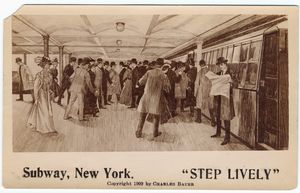
But many of my NYC pals using these apps (gouty or no) find it funny that they tend to go way past the limit of steps per day pretty early on each morning. That's because we live in a city where walking is just something you do, even during motorized commutes:


Subway, New York.  Step Lively... Digital ID: 836141. New York Public Library
It really hasn't changed all that much via NYPL Digital Gallery

We are a walkable city. It's been measured. Evidently, and not surprisingly, my NYC neighborhood has a walkability score of 100. Of, course, you can look at it from the other side: 3 or out 4 gas stations in the neighborhood closed in the past few years and there's no parking without a huge cost. And not that walkability always signifies a good thing to urban planners. You can look at the research that shows financial status can play a much bigger role in walkability as opposed to all other markers. (i.e. If you can't afford to drive, you won't).  This report that shows a correlation between high walkability and higher crime rates.

But that's not taking into account a place like NYC. We just move more.We sort of have to. 

So, lot's of walking, better diet ... was I a candidate for this dreaded "disease of kings?" Could I have done everything to prevent this issue? Slept more and eat even better? This study showed that while those people who slept less tended to eat for a longer period throughout the day, they did not intake more calories than those who slept longer. That doesn't quite take into account those of us binge eaters. Longer hours awake may mean more opportunities to binge. And this one showed that a low glycemic diet (in a controlled test) did show a lowering of weight, but did not really decrease inflammation, as it was thought it might. Although I'm pretty much already in the low GI fruit eating group anyway.

No, it may have just been fate that did me in.It was also pointed out that stress could have been a factor. So even with extra walking and good eating, I'm not sure I could have escaped this pain.

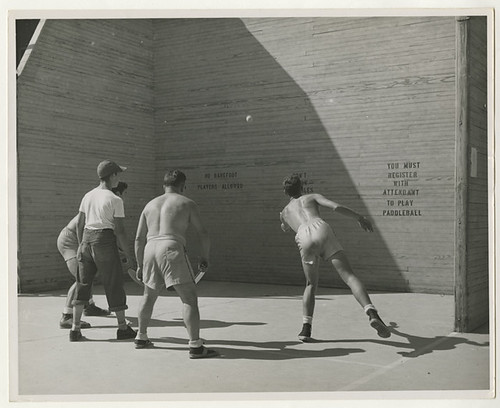
If it does come back (and man, I certainly do hope it does NOT), I just need to be more aware of the situations and how it might be better controlled. And I think that means being more aware, but also getting back to taking of advantage of this oh so walkable, moveable city of mine. It may not have made me the healthiest young adult, but it always has the potential to get you moving more:


Men and boys playing paddleball, Cincinnati, Ohio, circa 1950
Believe it or not, I even played this when I was a Retro fella. Via The Center for Jewish History on Flickr


References:


Carr, Lucas J., Shira I. Dunsiger, and Bess H. Marcus. “Walk ScoreTM As a Global Estimate of Neighborhood Walkability.” American Journal of Preventive Medicine 39, no. 5 (November 2010): 460–63. doi:10.1016/j.amepre.2010.07.007.

“How to Walk 10000 Steps a Day.” Dietitian without Borders. Accessed August 4, 2014. http://dietitianwithoutborders.com/walk-10000-steps-a-day/.

Juanola-Falgarona, Martí, Jordi Salas-Salvadó, Núria Ibarrola-Jurado, Antoni Rabassa-Soler, Andrés Díaz-López, Marta Guasch-Ferré, Pablo Hernández-Alonso, Rafael Balanza, and Mònica Bulló. “Effect of the Glycemic Index of the Diet on Weight Loss, Modulation of Satiety, Inflammation, and Other Metabolic Risk Factors: A Randomized Controlled Trial.” The American Journal of Clinical Nutrition 100, no. 1 (July 1, 2014): 27–35. doi:10.3945/ajcn.113.081216.

Kant, Ashima K., and Barry I. Graubard. “Association of Self-Reported Sleep Duration with Eating Behaviors of American Adults: NHANES 2005–2010.” The American Journal of Clinical Nutrition, September 1, 2014, ajcn.085191. doi:10.3945/ajcn.114.085191.

Manaugh, Kevin, and Ahmed El-Geneidy. “Validating Walkability Indices: How Do Different Households Respond to the Walkability of Their Neighborhood?” Transportation Research Part D: Transport and Environment 16, no. 4 (June 2011): 309–15. doi:10.1016/j.trd.2011.01.009.

Tuesday, July 8, 2014

The Illiteracy of Life

"Whaddaya mean 'illiterate'? My father and mother were married right here in the city hall!"- Dorothy McNulty (aka Penny Singleton) in After the Thin Man.

Ah, I love that movie.

There's a strong movement in many professions about literacy or one's knowledge about a certain subject. Certainly in my own profession of librarianship (or more often academic librarianship), there's a constant push for information literacy. Some professional library organizations like the Association of College and Research Libraries (or ACRL) spend an awful lot manpower on it. And virtually every academic library has to partake in this exercise.

To weigh over on the Librarian side of the Streamlined Ska persona, I have some serious issues with how information literacy is thrown en masse as THE answer to successful students navigating the ever changing resources in front of them. I'm more of a fan of developing critical thinking skills among library users and less of a specified learning objective. If I base technical proficiency for librarians based on when I was in Library School, well then, it probably hasn't changed much. I don't think being technically savvy is the answer to successful research. It's part of it, but just enabling one key phrase is not going to get youngsters to understand how to formulate a question in order to find an answer that might be more than just parroting their favorite website.

That's my very small nutshell. I would suggest reading Lane Wilkinson's take on ACRL's attempt to recast info lit in terms of threshold concepts to see a larger timeline and set of resources as to part of this argument.

"But what has this to do with food and weight maintenance," you ask? Well, we're now in the age of trying to teach food literacy. (I mean "we" in the sense of us all, although librarians did stick their nose in it, too.)

And it's very similar to info lit: If we teach the basic tenant of this subject to someone, they will better prepared to make an informed decision about their food intake. And a recent literature review of food literacy programs geared at adolescents shows ... that few of these initiatives show a positive impact on dietary choices. Even though the need is still there. Whomp-whomp.

And yet if you look at the 19 studies reviewed in this paper, they all had different learning outcomes. While they were all about getting a better understanding of healthy eating, there was not overriding method or exercise.

So we have librarians trying to agree on a set way of determining outcomes and we then have ... well, I was going to say "Dietitians and Nutritionists have many ways to determine outcomes," but that's not entirely true.

It seems a lot of people feel they can teach you to eat better and be more healthy, even without a professional accreditation. Information literacy still tends to stay in the Academic wheelhouse, and usually with the librarians. For food it's not always the professionals. Sort of in the same way as "Why do I need a library? It's all online." Anyone can write a cookbook.

Man, people are stupid.

Still, getting back to actual research in food literacy, I'm thinking the reason it's so difficult to tackle this in a uniform matter is that most people have very different concepts not only of food, but of themselves. It's one thing to say, "I prefer searching Lexis-Nexis to Westlaw." It's another to say, "I only eat vegetables that look and feel and taste this way," such as in this study from the Netherlands.  (Although as a long time former employee of a Dutch company, I rarely found any Dutch who liked their veggies raw or crunchy!)

Het spijt me, maar het is waar!

And let's look at this study about perceived body fat. While gender made a huge difference in results, it seems very few folks were correct in estimating their own body fat percentage nor were they satisfied with their current body fat.

So here we are studying ways to get folks to make better choices when they already cannot perceive themselves correctly nor do they prefer the taste and texture of healthier foods. How do you change that? How do you teach someone to make lifelong decisions that may often go against their internal make up? Is it the same as teaching a freshman how to better prepare a research question?

At this point, I suppose I could make a grand conclusion summarizing how once again the librarian and dietitian groups need to come together to create some universal moment of literacy. But I'm not, because I don't really think that'll work this time. Not that we shouldn't play together, but not like this.

Instead I really think we need to move into the idea of critical thinking. It's not if you're an expert on a subject. It's that you know enough to try to question WHY something might work for you, information or food-wise. And it opens up your mind to finding out more in order to make an informed decision that works for you.

I always say that's what makes a good librarian anyway. Perhaps that's also why the Streamlined Ska life has been manageable, as well!

ETA: I will say that most of my career OUTSIDE of academia, we never worried about this stuff. It was always just critical thinking.  

References:


Bongoni, R., R. Verkerk, M. Dekker, and L. P. A. Steenbekkers. “Consumer Behaviour towards Vegetables: A Study on Domestic Processing of Broccoli and Carrots by Dutch Households.” Journal of Human Nutrition and Dietetics, June 1, 2014, n/a–n/a. doi:10.1111/jhn.12245.

Brooks, Natalie, and Andrea Begley. “Adolescent Food Literacy Programmes: A Review of the Literature.” Nutrition & Dietetics, December 1, 2013, n/a–n/a. doi:10.1111/1747-0080.12096.

Campisi, J., K. E. Finn, Y. Bravo, J. Arnold, M. Benjamin, M. Sukiennik, S. Shakya, and D. Fontaine. “Sex and Age-Related Differences in Perceived, Desired and Measured Percentage Body Fat among Adults.” Journal of Human Nutrition and Dietetics, June 2014, n/a–n/a. doi:10.1111/jhn.12252.

“Information Literacy Resources.” Accessed July 8, 2014. http://www.ala.org/acrl/issues/infolit.

“The Problem with Threshold Concepts.” Sense & Reference. Accessed July 8, 2014. http://senseandreference.wordpress.com/2014/06/19/the-problem-with-threshold-concepts/.

Yang, Sharon Q., and Min Chou. “Promoting and Teaching Information Literacy on the Internet: Surveying the Web Sites of 264 Academic Libraries in North America.” Journal of Web Librarianship 8, no. 1 (2014): 88–104. doi:10.1080/19322909.2014.855586.

Tuesday, June 24, 2014

A Pinch of Oz

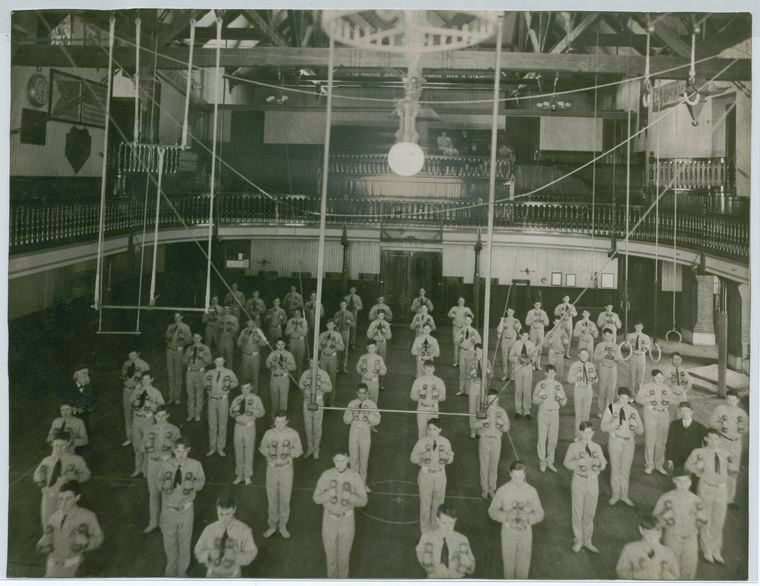
So, almost a year after getting my "Dear John" letter from my trainer, I finally bit the bullet. No, I didn't get a new trainer ... yet but I did decide to return to the bigger, more expensive gym where I first met him. And you really do get what you pay for:


Via the NYPL Digital Collections


Perhaps it's the initial giddiness of these first two weeks back in the old place (although the actual gym moved down the block, but it's still the same chain as before). The sheer happiness of finding fully equipped weight rooms, working squat racks, TRX bands, a decent amount of working cardio machines and even the semblance of regular cleaning so there's not a patina of mystery stains after using any stretching/abs/floor areas. Maybe that will wear off in a bit, but for now I can see the difference in my workout already. And that has had a positive effect on my food intake, as well.

Of course, there are a few of the regular flies in the health ointment. That huge cabinet of supplements still stands near the main entrance and the hard sell has begun. My last trainer had a reflex flinch every time we passed by that cabinet after our first session when I ripped him a new one and said if he ever tried to sell me one pill, our sessions were over. Harsh? Yes, but it worked!

But now the push is back. They even offered a welcome back goodie bag of the stuff (I declined). 

If you're running a place that pushes exercise and even nutrition as hard work (no judgements, and fun, but hard work) , why are you also then selling this "easy boost"? (It's rhetorical, I know why.)

I know this is a business model. I know this is a way to make some extra funds. But I see it as a mixed message. And yet, it's not like it's the only place trying to sell us a "cheating way to win."

I get sent lots of library links, cute tattoo videos, and of course, many links about nutrition and weight loss from a variety of my friends. Most of these are out on the usual social media memes, so I often receive them again and again.

And then Dr. Oz happened this past week. So I got a loooooot of links about it.

While I'm not surprised at the results of the hearing or the backlash around it, it does raise the question: If everyone supposedly thought Dr. Oz was a quack about these supplements, why did he still sell so many of them? My "professionals-of-another-degree-mother," the Registered Dietitians, have been weighing in on Oz's claims for quite some time, a lot of it critical towards the man. (Although there are some who use his show as their own PR sounding board). You think having some credential might be taken into account.

Yet we still all want to believe that something will be a "miracle," especially when it comes to our health and weight. One study a few years back showed that the majority of people surveyed did believe that dietary supplements would help in obesity. The numbers were higher for people who were overweight or obese. Yet results, especially those from evidence-based research, show that the efficacy and safety of these supplements is still unknown, and even the ones from "natural ingredients" have not been shown in any positive results of dieting individuals.

And these are often the same people who "eat clean" or deny certain basic food groups. They'll still take a mystery concoction that is "magic"? Is it ethical to promise a miracle, especially if you have a few initials after your name and a global audience?

There's nothing wrong with having faith that you can achieve whatever you want for your body in terms of being healthier. But I'd rather do it on my own belief that "mystery miracles" are not part of the equation.

via The Smithsonian Collection

Yeah ... no.

References:


Laddu, Deepika, Caitlin Dow, Melanie Hingle, Cynthia Thomson, and Scott Going. “A Review of Evidence-Based Strategies to Treat Obesity in Adults.” Nutrition in Clinical Practice 26, no. 5 (October 1, 2011): 512–25. doi:10.1177/0884533611418335.

Pillitteri, Janine L., Saul Shiffman, Jeffrey M. Rohay, Andrea M. Harkins, Steven L. Burton, and Thomas A. Wadden. “Use of Dietary Supplements for Weight Loss in the United States: Results of a National Survey.” Obesity 16, no. 4 (April 1, 2008): 790–96. doi:10.1038/oby.2007.136.


Sunday, June 1, 2014

That diet is bananas!

First, if I may:


LET'S GO RANGERS!!!!! WHOOOP!! WE WANT THE CUP! 

OK, now where were we...

A browse through some of my recent cookbooks acquisitions brought this little ditty to light:


via The Buffet Cookbook
 
This is not something met with my usual lip smacking culinary fantasy. However, it seems this was a fairly common recipe in mid-century cookbooks. And I was intrigued. Instead of getting immediately creative, I followed the recipe pretty much to the letter (except I halved it). The result?


Ummmm...no. Granted, my dinner guest thought it was delicious. I thought it tasted like, well, bananas mashed into beef. Blerk.

This might have been good with some sort of curry or jerk spice. Something tangy-spicy to interact with the bananas.

To me, it was a failure. Even if the blog reviews of this recipe were saying it was amazing.You can't believe everything you read.

Which is why this particular article in the NY Times made me a little nervous, at least by it's headline. Men losing 11 pounds in only 4 days? If you look at the full study, overweight men were given severe caloric restriction (360 cal/day!) combined with intense exercise, then continuing increase exercise for another week. And surprise, these men lost a lot weight. And they seemed to have kept it off after a year. But even the scientists confirmed that this needs more observation and it may not be ideal for those without the initiative.
But also, there was a only a handful of men in the study, so this cannot be considered a universal solution, just yet.

Also, looking at it in perspective, when I started my Streamlined lifestyle change, I worked out with my first trainer that if I cut my intake to 2700 cal/day, but increased my exercise, I could maintain my goal of a one lb. of weight loss per week.

Now that was already a huge calorie drop for me. Doing a quick and dirty calorie count on Retro Ska Librarian meals, I was probably taking in 4000-6000 cal/day. Way more than any recommended daily allowance. So coming down to 2700 was already a shift, never mind that it also meant I should be engaging in "intensive exercise" at least 5 days a week (otherwise weight loss would have been only do to even less calories).  I cannot imagine handling 360 cal/day. That's not even a bagel or a beer.

So while this is an eyebrow raising study, do we see it fitting into a healthy lifestyle change? I'm sure someone will try to bank on that! 

"The Danish Starvation Diet! Eat like a Little Mermaid!"

But what makes it more difficult could be our overall diet. A brief written for JAMA has two doctors saying it is the way we store fuel in fat cells that can actually prevent us form properly losing weight. Coming back to the theory that it's not how much you eat, but what you eat. 

I'm not sure how I feel about this theory, and it is just that at the moment, a theory. Taken at it's basics, yes, it is healthier when you count calories to try to eat healthier foods (I suppose 2700 cal/day of frosting tubs would have not have been very smart of me to do).

But will this idea throw more people into the arms of "quick fix" diets and pills, as they feel they are "doomed" by their fat cells? Frank Bruni, fellow former pudgy guy, does see it as a problem that we all fall into:

"And the vogue for painstakingly tailored eating regimens and dieting techniques is to some extent a distraction from that, a dangerous one, because it promotes the idea that basic nature and fundamental biology can somehow be gamed, cheated, transcended."


There is no cheat. There is no extreme way of doing this. And I can no longer buy into any special diet.

It is highly possible that my fat cells have been so overworked that weight loss for me might be harder. But I did do it, without denying myself anything out of the ordinary. However, maybe those "trigger" foods are what these doctors are talking about.  I don't know, I just know what worked and it wasn't advertised on TV.

In any case, there is no easy answer. Never was. Never will be. You want a miracle, look at those beautiful NY Rangers! It took 20 years, but they finally hit their goal! (OK, ouch...)

 
References:


4 Days, 11 Pounds. (n.d.). Well. Retrieved May 23, 2014, from http://well.blogs.nytimes.com/2014/05/22/4-days-11-pounds/


Bruni, Frank. “Diet Lures and Diet Lies.” The New York Times, May 26, 2014. http://www.nytimes.com/2014/05/27/opinion/bruni-diet-lures-and-diet-lies.html.


Calbet, J. a. L., Ponce-González, J. G., Pérez-Suárez, I., de la Calle Herrero, J., & Holmberg, H.-C. (2014). A time-efficient reduction of fat mass in 4 days with exercise and caloric restriction. Scandinavian Journal of Medicine & Science in Sports, n/a–n/a. doi:10.1111/sms.12194

Ludwig DS, & Friedman MI. (2014). Increasing adiposity: Consequence or cause of overeating? JAMA. doi:10.1001/jama.2014.4133