Showing posts with label Food. Show all posts

Friday, April 10, 2015

If I Put "Babe" in My Name....

Would that get me better hits on this site?

Maybe I should just blog more! 

Welcome back! It's been quite a few months. There's been some major PT for my leg which means less streamline lifestyle for now. But I'm trying to focus on the positive. I'm learning Danish. And I can only imagine it will be very helpful when I tell Danish librarians, "I er ikke mine rigtige forældre! Hvorfor er min haj i ændernes svømmebassin?" (Yes, those are sentences from my lessons.)

This is a short entry, but I thought I'd chime in because we're finally seeing some true social media backlash on a lot of the crap I've written about in the past. And now it's centered squarely on the Food Babe.

Aside from the latest piece which was shared worldwide, it's not like people haven't already been criticizing her in the media and on campuses.

And it's been fun to see. In fact, go check out #foodbabefacts on twitter.


I'm not saying you can't be skeptical about what might be in food, but please...I say this as a librarian....DO SOME PROPER RESEARCH!!!!!!!!!!

I'm flabbergasted that we allow such inanity in our discourse about health and wellness. You know, Food Babe, there's been quite a lot of research out there on health literacy. It's been a concern for decades. It's not about scaring folks into believing we're all being poisoned. It's about learning to handle information to turn it into proper knowledge. 

I would suggest you might visit your local library soon. You might actually learn something. 

Share information, everyone. Just do it wisely. 


The Streamlined Ska Librarian Babe. (Now I just need my own army...)


References:


“Food Babe Visits My University | Illumination.” Accessed April 10, 2015. http://kfolta.blogspot.com/2014/10/food-babe-visits-my-university.html.

“Is The Food Babe A Fearmonger? Scientists Are Speaking Out : The Salt : NPR.” Accessed April 10, 2015. http://www.npr.org/blogs/thesalt/2014/12/04/364745790/food-babe-or-fear-babe-as-activist-s-profile-grows-so-do-her-critics.

“The ‘Food Babe’ Blogger Is Full of Shit.” Accessed April 10, 2015. http://gawker.com/the-food-babe-blogger-is-full-of-shit-1694902226.

Nutbeam, Don. Health literacy as a public health goal: a challenge for contemporary health education and communication strategies into the 21st century Health Promot. Int. (2000) 15 (3): 259-267 doi:10.1093/heapro/15.3.259 


Sunday, September 14, 2014

Like broccoli in a brownie

One of the research links in the previous post addressed how one's tastes are more or less set at a young age. Which may account for my less than favorable opinions of peas.
Stupid peas...think they're so special!
 
It's funny, because I do love pea soup, I adore sauteed pea greens, and I don't mind throwing a handful of peas into a dish for some crunch or color (such as last week's Ancho Carbonara). But a serving of peas with a meal? Meh. I'd rather not.

But I know why this is. Peas were the one ubiquitous vegetable at dinner when I was growing up. We always had other veggies, too, but my dad insisted on peas, almost every night. And unlike much of my parent's other food "experiments" with recipes doomed to scare small children, peas were always served as is: defrosted from a bag and then put on our plates. 

This may speak more to the fact that my mom probably didn't care too much about them and my dad only wanted them as is. They weren't presented as tasty. Merely mandatory. 

And even though I was a surprisingly picky eater, I did scarf down other vegetables. Brussel sprouts, broccoli, spinach, carrots ... yes, please. But peas...I'd hide them in my napkin.

So it should not be surprising that, as an adult, I rarely if ever have peas in the house, nor do I go out of my way to order them in restaurants. It's not like I hate them. They just don't come up in my list of foods to think about. 

Sorry, peas.

Around the same time as my napkin hiding escapades, came a product that was supposed to handle such an issue: I Hate Peas.

These were basically vegetables reconstituted with potatoes (and other ingredients) to make french fries.  And they came in other vegetable flavors, too.

Via

(I had hoped to find the TV Commercial online, but no dice.)  


Even back then, I thought this was a bad idea. Really? French fries as a substitute for everything? 

Now I can really see that my parent's feeding habits of us kids helped me be open to trying most everything. That is especially apparent watching some adult friends and acquaintances who avoid certain groups of foods altogether. It's one thing to not like a a particular food's taste or texture (I was married to someone who hated the pulp of tomatoes. I'm currently dating someone who does not like the taste of cucumbers. We manage.) It's entirely something else to meet folks into their 30s and 40s who won't eat any vegetables or fresh fruit because they find them all "icky".

And I believe these were the people who were probably snuck their "healthy" foods into their "regular" meals. And that's not so unique. You can find tons of blogs about it, so much so that other bloggers have complained about it. (In-fighting among the foodies!)

Even scientific studies have shown that both scientists and moms felt that "stealth veggie-ing" was the effective way to introduce healthy energy-dense food to youngsters.      

But then we end up with folks who only eat deep fried greens and perpetuate this madness by following Jerry Seinfeld's wife into hiding broccoli in your cupcakes.

So, much as I don't often say it...thanks, Mom and Dad, for serving me those awful peas every meal, along with the strangely crisp eggplants, the home made sushi and "crepe night." Without all that, we wouldn't have the Streamlined Ska Librarian recipes we see today.

Stupid peas....


References:


Caton, Samantha J., Sara M. Ahern, and Marion M. Hetherington. “Vegetables by Stealth. An Exploratory Study Investigating the Introduction of Vegetables in the Weaning Period.” Appetite, Feeding infants and young children: guidelines, research and practice, 57, no. 3 (December 2011): 816–25. doi:10.1016/j.appet.2011.05.319.

“Dear Ninja Vegetable Mom: You’re Raising Kids Wrong.” Accessed September 14, 2014. http://www.foodretro.com/dear-ninja-vegetable-mom-youre-raising-kids-wrong/.

Spill, Maureen K., Leann L. Birch, Liane S. Roe, and Barbara J. Rolls. “Hiding Vegetables to Reduce Energy Density: An Effective Strategy to Increase Children’s Vegetable Intake and Reduce Energy Intake.” The American Journal of Clinical Nutrition 94, no. 3 (September 1, 2011): 735–41. doi:10.3945/ajcn.111.015206.


Thursday, September 11, 2014

Failing homemakers, or Spice up that Carbonara!


The other day I cooked with goat's milk. It wasn't any definitive recipe or attempt at being more "organic" or "natural" (Goats aren't exactly wandering around downtown Manhattan), but I was in the dairy aisle, it was on sale in half a liter size containers , and I felt like trying it.

The results were tasty, although I can't say for sure goat's milk lent that final piece of specialness. And the results certainly weren't any healthier because a goat was involved.

And then there was this bit of experimentation: Ancho Whole Wheat Carbonara


Mmmm...that's a spicy pasta!

Not as light as my fluffy dinner balls, but a pretty amazing piece of work. In fact, here's the recipe:

The Streamlined Ska Librarian's Ancho Whole Wheat Carbonara
(Serves 2-4, depending on portion needs)

2-3 dried ancho chiles
1 cup boiling water
1/2 pound smoked bacon, chopped into pieces (or other smoked not-too-lean meat)
2 Tbsp olive oil
1 cup corn (fresh or frozen)
1 cup peas (fresh or frozen)
1 cup onion, diced
3 cloves garlic, diced
Apple Cider Vinegar
Chicken Stock
3 eggs
1 cup half & half (or other fatty dairy milk product)
1 cup Asiago cheese, grated
Salt & pepper to taste (depending on meat choices, you may need extra salt).
1/2 lb whole wheat pasta

1. Stem and seed chiles, place in bowl and pour boiling water over to cover. Let steep for at least 15 minutes
2. Puree chiles (with water)  in processor until smooth
3. Sautee the bacon pieces until crispy. Drain on paper towel.
4. In same pan, add olive oil, corn, peas, onion and garlic. Sautee until beginning to brown. Deglaze pan with vinegar and stock. Keep flame on low and stir veggies occasionally.
5. In separate bowl,  beat, eggs, half & half, 1/2 cup cheese and chile puree until mixed.
6. Boil pasta until just al dente.
7. Drain pasta (saving some of the water). Put pasta back in pot. Add veggies, bacon and egg-chile mixture and stir until incorporated. Add a few spoons of pasta water if needed.
8. Top with rest of cheese, pepper and salt, if needed.

(and for dessert, there was goat's milk pudding!)

It's been a while since I've put something like this together on a weeknight. I realize that's one of the possible upsides of my recent cohabitation: I'm willing to cook more elaborately because someone else is doing all the dishes! And this recipe does leave a lot of stuff to be washed.

It is definitely the drudgery of domesticity which can prevent a lot of more "home spun" creations. It's time consuming, it can be economically unfeasible and sometimes just not pleasant.

Which is why I am once again rolling my eyes at Michael Pollan and his call for the "old fashioned" ways. In the past few years, he's been touting that home-cooked meals eaten with the family are what's truly missing from our lives now and blame is placed solely on those modern thinking housewives. (I've ranted about his smug attitude before). 

I love cooking. I even love healthy Streamlined cooking. I love the sense of creating and sharing something out of food, even if it's just for my own gullet. But when I've worked 12 hours and still want to get some stress relieving exercise in the mix and have to clean the house, do homework, and yes, write this blog, well then, I'm not above going the less than "made from scratch" route. Or even a pizza or pannini from down the street.  


A recent study did show that perhaps the decrease in household maintenance has contributed to decrease in energy expenditure which one can try to correlate to an increase in obesity. Although it doesn't really take into account that perhaps energy is being expended elsewhere. 

But is that what we're looking for? Women who do nothing but chop wood, milk cows, mill grain, and start cooking the meal at 5 AM so we can have dinner? I think most modern working mothers (at whom Pollan seems to be aiming) really do not have time for this crap. Even my mother, she of Julia Child influence and natural "treats," didn't always make her own tofu and pickle her own crab-apples from our backyard tree. She had better things to do.

A recent sociology-anthropolgy study on this topic takes Pollan to task:

"While Pollan and others wax nostalgic about a time when people grew their own food and sat around the dinner table eating it, they fail to see all of the invisible labor that goes into planning, making, and coordinating family meals. Cooking is at times joyful, but it is also filled with time pressures, tradeoffs designed to save money, and the burden of pleasing others"

Basically, we have been creating ways to ease the burden of much our worklife, but it's supposedly bad when we then deny this nostalgic view among those who can afford to have said nostalgia. 

Yes, you shouldn't just shovel fast food at the family for dinner all the time. There are studies that show that kids' tastes start early, so healthier dishes and fruits and vegetables thrown in between the mac and cheese dinners might make for better choices as they get older.  

But we're not in Donna Reed land anymore. Even Donna Reed wasn't in that land:

OK, enough award-winning "bad girl" roles, Miss Reed. Those radishes aren't going to rosette themselves!


So, Mr. Pollan, go try working for drudge wages and see if you still want to pluck your own ducks before starting the home made croquembouche. The rest of us have reality to deal with. 

Experiment in the kitchen. Just don't chain yourself to it.


References:

Archer, Edward, Robin P. Shook, Diana M. Thomas, Timothy S. Church, Peter T. Katzmarzyk, James R. Hébert, Kerry L. McIver, Gregory A. Hand, Carl J. Lavie, and Steven N. Blair. “45-Year Trends in Women’s Use of Time and Household Management Energy Expenditure.” PLoS ONE 8, no. 2 (February 20, 2013): e56620. doi:10.1371/journal.pone.0056620.


Bowen, Sarah, Sinikka Elliott, and Joslyn Brenton. “The Joy of Cooking?” Contexts 13, no. 3 (August 1, 2014): 20–25. doi:10.1177/1536504214545755.


Louis, Catherine Saint. “Childhood Diet Habits Set in Infancy, Studies Suggest.” The New York Times, September 2, 2014. http://www.nytimes.com/2014/09/02/health/childhood-diet-habits-set-in-infancy-studies-suggest.html.

Thursday, August 7, 2014

Happy fluffy dinner balls

[No references, just a recipe]

It's just been a wacky week. Along with gout recovery, we're finally getting repairs done on the apartment. Repairs that were needed from Superstorm Sandy. And of course, some of the "simpler" fixes have turned into multi-day event dramas:


I just wanna take a shower!
So between work obligations, dealing with maintenance men and having newish pets still acclimating to each other (and said maintenance men), all of a sudden it's 6 PM and dinner has to be on the table. 

What's a streamlined ska librarian to do?

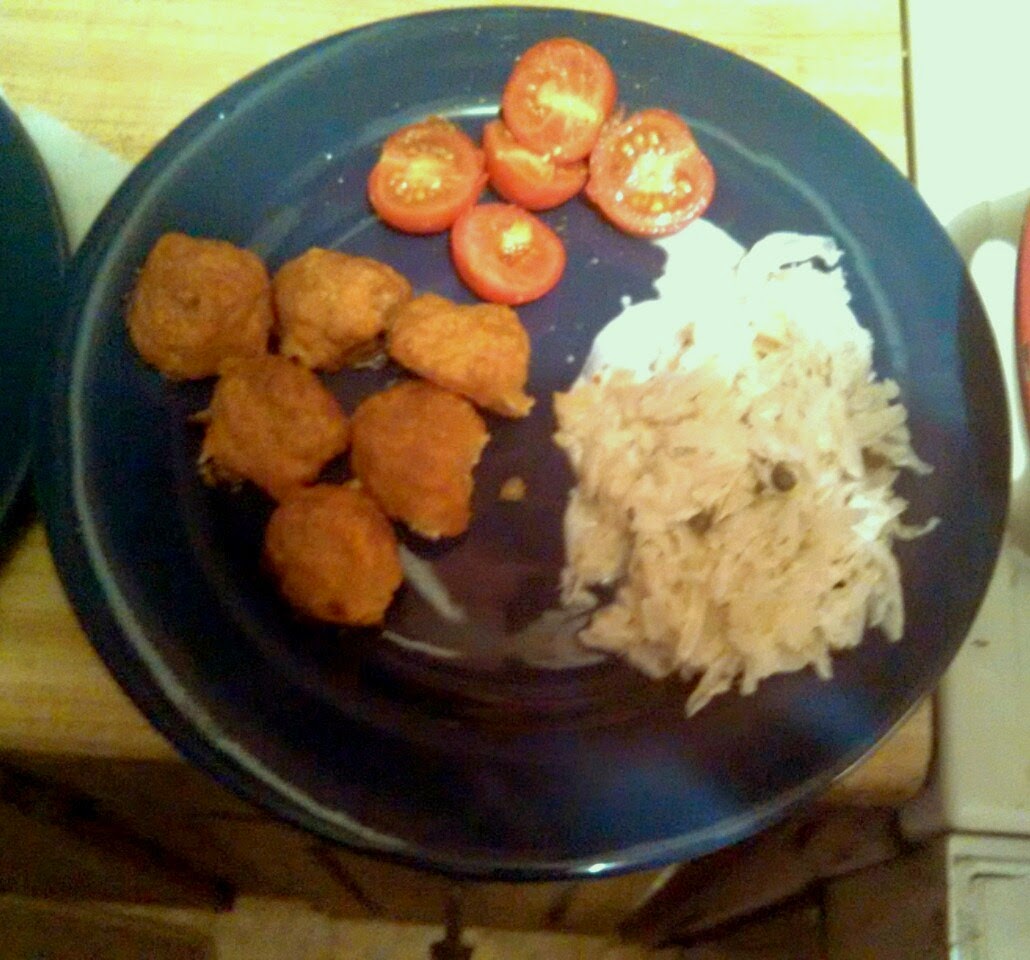
Thankfully we had some ground turkey, and meatballs are usually quick, but I wanted to kick them up a bit and still keep them healthy. I had some yams, egg whites and tons of spices. And then I added a little molasses for contrast and taste and also to help create some caramelization. They were very light and barely solid, but I didn't want to go the flour route, so I threw in a little corn meal.

The result?


Not the best photo but I'll leave that to the "foodies"
They were amazingly fluffy and wonderfully fragrant with just the right molasses crust on the bottom. Paired with a little sauerkraut cooked in a sherry-sour cream sauce and fresh tomatoes with zataar....perfection after a stressful day!


The Streamlined Ska Librarian's Fluffy Spicy Meatballs
(Serves 4-6)


1 lb. ground turkey
3 TBS. Tandoori spice blend (I buy mine from my local fave, Dual Specialty Store.)
2 tsps. minced garlic
1 TBS. dried ginger
2 TBS. molasses
2 egg whites
1 1/2 cups cooked sweet potato or yam
1/2 cup corn meal

1. Preheat oven to 350F
2. In large bowl, combine all ingredients until well blended
3. Form into balls about 1 1/2 to 2 in in diameter
4. Place on oiled baking pan
5. Bake until done (about 30-45 min.)


Monday, August 4, 2014

What's Next...Lumbago?

This post took longer than expected. In fact, it was supposed to be about another topic and released before the end of last month. But then I developed gout. Yes, you read that right. And, boy, was it not pleasant!


The gout james gillray
There is no exaggeration to this image.(Via Wikimedia Commons)

I find it ironic that during my Retro Ska Librarian Lifestyle (aka Sedentary, Binge Eating Unhealthy Diet Life of Dan), this never happened. But a few years into Streamlined, Leafy Green, Daily Workout Ska Librarian Life of Dan .... hot poker glass shard demons jam into my bunion joint.

I'm hoping this was a one time event and not a chronic condition. And forcing myself to spend several days immobile with my foot up has once again made me realize how much I really need and want to move on a daily basis.

(What's also fascinating is finding out how many of my friends are gout sufferers. Who knew this persnickety affliction affected so many? I guess I know a better class of people than I thought!)

I tried to avoid too many fitness and nutrition websites during my recovery, lest I get too antsy, but I did start falling back to the Nutrition Blog Network, figuring my RD "colleagues of another terminal degree" might give me some interesting recipe ideas. And from that website, I came across this recent post from Dietitian Without Borders on "How to Walk 10,000 Steps a Day".

And here I can only walk zero! *sob*

But it did give me an idea for a blog post. All those steps...

I see a lot of friends and colleagues with the FitBit bracelet nowadays. Interestingly enough, many of these were gifts to these people from loved ones. Nothing like passive-aggressively telling someone to move more...

Don't get me wrong. I think it's great if you want to keep track of moving. And, as that aforementioned link shows, it's something we should probably all be doing in simple easy ways. I see it in the same vein as calorie-tracking, which I'm sure will get me in trouble, as that seems no longer a supportable choice for weight loss and maintenance. 

But I look at it as a template. I can see calorie levels and get a better understanding of portion control, even if not I'm not following calorie counting to the exact digit. And knowing that 10,000 steps is equivalent to 5 miles, well that can give you a better sense of how much you should really be moving. And when these FitBit and similar apps show you how much you actually move ... I'm sure it's an eye opener.

But many of my NYC pals using these apps (gouty or no) find it funny that they tend to go way past the limit of steps per day pretty early on each morning. That's because we live in a city where walking is just something you do, even during motorized commutes:


Subway, New York.  Step Lively... Digital ID: 836141. New York Public Library
It really hasn't changed all that much via NYPL Digital Gallery

We are a walkable city. It's been measured. Evidently, and not surprisingly, my NYC neighborhood has a walkability score of 100. Of, course, you can look at it from the other side: 3 or out 4 gas stations in the neighborhood closed in the past few years and there's no parking without a huge cost. And not that walkability always signifies a good thing to urban planners. You can look at the research that shows financial status can play a much bigger role in walkability as opposed to all other markers. (i.e. If you can't afford to drive, you won't).  This report that shows a correlation between high walkability and higher crime rates.

But that's not taking into account a place like NYC. We just move more.We sort of have to. 

So, lot's of walking, better diet ... was I a candidate for this dreaded "disease of kings?" Could I have done everything to prevent this issue? Slept more and eat even better? This study showed that while those people who slept less tended to eat for a longer period throughout the day, they did not intake more calories than those who slept longer. That doesn't quite take into account those of us binge eaters. Longer hours awake may mean more opportunities to binge. And this one showed that a low glycemic diet (in a controlled test) did show a lowering of weight, but did not really decrease inflammation, as it was thought it might. Although I'm pretty much already in the low GI fruit eating group anyway.

No, it may have just been fate that did me in.It was also pointed out that stress could have been a factor. So even with extra walking and good eating, I'm not sure I could have escaped this pain.

If it does come back (and man, I certainly do hope it does NOT), I just need to be more aware of the situations and how it might be better controlled. And I think that means being more aware, but also getting back to taking of advantage of this oh so walkable, moveable city of mine. It may not have made me the healthiest young adult, but it always has the potential to get you moving more:


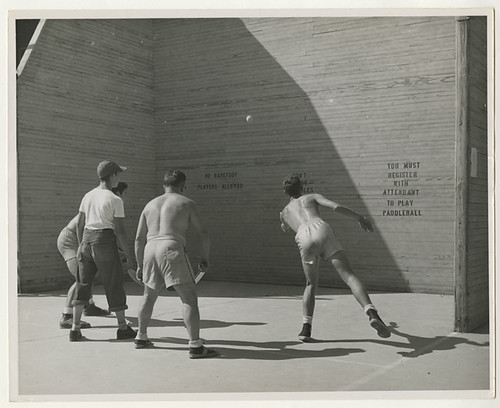
Men and boys playing paddleball, Cincinnati, Ohio, circa 1950
Believe it or not, I even played this when I was a Retro fella. Via The Center for Jewish History on Flickr


References:


Carr, Lucas J., Shira I. Dunsiger, and Bess H. Marcus. “Walk ScoreTM As a Global Estimate of Neighborhood Walkability.” American Journal of Preventive Medicine 39, no. 5 (November 2010): 460–63. doi:10.1016/j.amepre.2010.07.007.

“How to Walk 10000 Steps a Day.” Dietitian without Borders. Accessed August 4, 2014. http://dietitianwithoutborders.com/walk-10000-steps-a-day/.

Juanola-Falgarona, Martí, Jordi Salas-Salvadó, Núria Ibarrola-Jurado, Antoni Rabassa-Soler, Andrés Díaz-López, Marta Guasch-Ferré, Pablo Hernández-Alonso, Rafael Balanza, and Mònica Bulló. “Effect of the Glycemic Index of the Diet on Weight Loss, Modulation of Satiety, Inflammation, and Other Metabolic Risk Factors: A Randomized Controlled Trial.” The American Journal of Clinical Nutrition 100, no. 1 (July 1, 2014): 27–35. doi:10.3945/ajcn.113.081216.

Kant, Ashima K., and Barry I. Graubard. “Association of Self-Reported Sleep Duration with Eating Behaviors of American Adults: NHANES 2005–2010.” The American Journal of Clinical Nutrition, September 1, 2014, ajcn.085191. doi:10.3945/ajcn.114.085191.

Manaugh, Kevin, and Ahmed El-Geneidy. “Validating Walkability Indices: How Do Different Households Respond to the Walkability of Their Neighborhood?” Transportation Research Part D: Transport and Environment 16, no. 4 (June 2011): 309–15. doi:10.1016/j.trd.2011.01.009.

Sunday, July 20, 2014

Hitching a ride on names

For many years, I had heard about Marcella Hazan's famous tomato sauce recipe: an incredibly simple idea with what looks like not enough ingredients that somehow becomes something magical. Crushed tomatoes, butter and an onion, cooked for about 40 min. That's it.

I've talked before about not following recipes to the letter, but I do like to try them out correctly on the first go, before I decide what I can do to tweak them to my taste. So I made Marcella's recipe as it was written.

Oh. My. God.

There are some creations of masters with which you do not tamper! It was pretty amazing both in its simplicity and it's final complex taste. My only concession is that the end product does not always end up on pasta. I use it on veggies, meats and on occasion, just plain toast.

Heinz - Woman with tomato shap... Digital ID: 1675405. New York Public Library
Mmm...funny shaped tomatoes! via NYPL Digital Gallery


I don't see it as an everyday sauce. (that's a lotta butter for my everyday Streamlined lifestyle!) And sometimes I do want different flavors and textures, but then what I am making is not Marcella's sauce.

And doing a brief search around the internet, you see quite a few photoshopped versions of the sauce, but there's also a few where someone decides to "modernize it just a bit." Perhaps "veganizing" or "paleo-ing" it up. 

And a lot of those "modernizations" usually include substituting butter with olive oil and perhaps adding garlic, basil, hot peppers, etc.

Which means you're making ANOTHER SAUCE!  

There's nothing wrong with making other sauces. I myself love garlic and basil in tomatoes, or chilis, or fish sauce or assorted vinegars and curries, but I can't stretch that to say I'm making a"modified" Marcella sauce. The whole purpose of it is that it really is just those three ingedients. 

And all those other recipe bloggers ...you're just using name recognition to try to get some more attention. I find this ironic as more and more folks are trying to find "food authenticity" and yet you're completely changing something while claiming this provenance. 

Harsh? Yeah, but we see that even more so in the fitness world. Yoga has been reiterated so many ways that it's become impossible to know what is considered that form of exercise. Pilates has gained so many "improvements" that I can only wonder that the canterkerous old boxer would probably smack all these modern practitioners. 

But the biggest shift I see is taking all these exercise regimens and making them more ... comfortable. Basically creating a spa environment for what should probably be just a sweaty time. 

Take this recent article about a new CrossFit studio in NYC. I'm not a huge fan of CrossFit; I have far too many leg and hip injuries and, as I've said before, I'm not too big on team exercise classes or events. So, not putting it down, but it's not for me. And what I do like about it is that it's about movement and exercise taken to a rather basic form. 

But here's a studio looking to "deliver the luxury-level amenities to the CrossFit community" by adding yoga, spa treatments and the like.

So is this still CrossFit? Isn't this really ... a spa & gym? It seems to me that they're just taking the name and using it as a marketing ploy. 

Or is it that people just don't like exercise to be basic and dirty? They need pampering along with a name exercise?

The spa, Central Park. Digital ID: 800960. New York Public Library
Do they have pull up bars at this spa? Or is just hot yoga? via NYPL Digital Gallery
I get that people need a push. This study shows that overweight subjects found exercise less pleasurable the more they had to exert during the exercise. And that, of course, led to less adherence to the exercise regime.

But is claiming a name making it more palatable? I don't think you'll get more intense exercise out of added facials and rubdowns. 

Exercise is still hard. And calling something that it's not is merely pasting glitter on the same idea. Trying to make yourself popular without actually BEING the thing in question is just bad form.

I'll just wait for butter to be included in my pilates workout, then.


References:

Ekkekakis, P., and E. Lind. “Exercise Does Not Feel the Same When You Are Overweight: The Impact of Self-Selected and Imposed Intensity on Affect and Exertion.” International Journal of Obesity 30, no. 4 (2006): 652–60. doi:10.1038/sj.ijo.0803052.


“Is ‘CrossFit Chic’ Coming to New York City?” Well+Good NYC. Accessed July 16, 2014. http://wellandgood.com/2014/07/07/is-crossfit-chic-coming-to-new-york-city/.

Tuesday, July 8, 2014

The Illiteracy of Life

"Whaddaya mean 'illiterate'? My father and mother were married right here in the city hall!"- Dorothy McNulty (aka Penny Singleton) in After the Thin Man.

Ah, I love that movie.

There's a strong movement in many professions about literacy or one's knowledge about a certain subject. Certainly in my own profession of librarianship (or more often academic librarianship), there's a constant push for information literacy. Some professional library organizations like the Association of College and Research Libraries (or ACRL) spend an awful lot manpower on it. And virtually every academic library has to partake in this exercise.

To weigh over on the Librarian side of the Streamlined Ska persona, I have some serious issues with how information literacy is thrown en masse as THE answer to successful students navigating the ever changing resources in front of them. I'm more of a fan of developing critical thinking skills among library users and less of a specified learning objective. If I base technical proficiency for librarians based on when I was in Library School, well then, it probably hasn't changed much. I don't think being technically savvy is the answer to successful research. It's part of it, but just enabling one key phrase is not going to get youngsters to understand how to formulate a question in order to find an answer that might be more than just parroting their favorite website.

That's my very small nutshell. I would suggest reading Lane Wilkinson's take on ACRL's attempt to recast info lit in terms of threshold concepts to see a larger timeline and set of resources as to part of this argument.

"But what has this to do with food and weight maintenance," you ask? Well, we're now in the age of trying to teach food literacy. (I mean "we" in the sense of us all, although librarians did stick their nose in it, too.)

And it's very similar to info lit: If we teach the basic tenant of this subject to someone, they will better prepared to make an informed decision about their food intake. And a recent literature review of food literacy programs geared at adolescents shows ... that few of these initiatives show a positive impact on dietary choices. Even though the need is still there. Whomp-whomp.

And yet if you look at the 19 studies reviewed in this paper, they all had different learning outcomes. While they were all about getting a better understanding of healthy eating, there was not overriding method or exercise.

So we have librarians trying to agree on a set way of determining outcomes and we then have ... well, I was going to say "Dietitians and Nutritionists have many ways to determine outcomes," but that's not entirely true.

It seems a lot of people feel they can teach you to eat better and be more healthy, even without a professional accreditation. Information literacy still tends to stay in the Academic wheelhouse, and usually with the librarians. For food it's not always the professionals. Sort of in the same way as "Why do I need a library? It's all online." Anyone can write a cookbook.

Man, people are stupid.

Still, getting back to actual research in food literacy, I'm thinking the reason it's so difficult to tackle this in a uniform matter is that most people have very different concepts not only of food, but of themselves. It's one thing to say, "I prefer searching Lexis-Nexis to Westlaw." It's another to say, "I only eat vegetables that look and feel and taste this way," such as in this study from the Netherlands.  (Although as a long time former employee of a Dutch company, I rarely found any Dutch who liked their veggies raw or crunchy!)

Het spijt me, maar het is waar!

And let's look at this study about perceived body fat. While gender made a huge difference in results, it seems very few folks were correct in estimating their own body fat percentage nor were they satisfied with their current body fat.

So here we are studying ways to get folks to make better choices when they already cannot perceive themselves correctly nor do they prefer the taste and texture of healthier foods. How do you change that? How do you teach someone to make lifelong decisions that may often go against their internal make up? Is it the same as teaching a freshman how to better prepare a research question?

At this point, I suppose I could make a grand conclusion summarizing how once again the librarian and dietitian groups need to come together to create some universal moment of literacy. But I'm not, because I don't really think that'll work this time. Not that we shouldn't play together, but not like this.

Instead I really think we need to move into the idea of critical thinking. It's not if you're an expert on a subject. It's that you know enough to try to question WHY something might work for you, information or food-wise. And it opens up your mind to finding out more in order to make an informed decision that works for you.

I always say that's what makes a good librarian anyway. Perhaps that's also why the Streamlined Ska life has been manageable, as well!

ETA: I will say that most of my career OUTSIDE of academia, we never worried about this stuff. It was always just critical thinking.  

References:


Bongoni, R., R. Verkerk, M. Dekker, and L. P. A. Steenbekkers. “Consumer Behaviour towards Vegetables: A Study on Domestic Processing of Broccoli and Carrots by Dutch Households.” Journal of Human Nutrition and Dietetics, June 1, 2014, n/a–n/a. doi:10.1111/jhn.12245.

Brooks, Natalie, and Andrea Begley. “Adolescent Food Literacy Programmes: A Review of the Literature.” Nutrition & Dietetics, December 1, 2013, n/a–n/a. doi:10.1111/1747-0080.12096.

Campisi, J., K. E. Finn, Y. Bravo, J. Arnold, M. Benjamin, M. Sukiennik, S. Shakya, and D. Fontaine. “Sex and Age-Related Differences in Perceived, Desired and Measured Percentage Body Fat among Adults.” Journal of Human Nutrition and Dietetics, June 2014, n/a–n/a. doi:10.1111/jhn.12252.

“Information Literacy Resources.” Accessed July 8, 2014. http://www.ala.org/acrl/issues/infolit.

“The Problem with Threshold Concepts.” Sense & Reference. Accessed July 8, 2014. http://senseandreference.wordpress.com/2014/06/19/the-problem-with-threshold-concepts/.

Yang, Sharon Q., and Min Chou. “Promoting and Teaching Information Literacy on the Internet: Surveying the Web Sites of 264 Academic Libraries in North America.” Journal of Web Librarianship 8, no. 1 (2014): 88–104. doi:10.1080/19322909.2014.855586.

Sunday, June 1, 2014

That diet is bananas!

First, if I may:


LET'S GO RANGERS!!!!! WHOOOP!! WE WANT THE CUP! 

OK, now where were we...

A browse through some of my recent cookbooks acquisitions brought this little ditty to light:


via The Buffet Cookbook
 
This is not something met with my usual lip smacking culinary fantasy. However, it seems this was a fairly common recipe in mid-century cookbooks. And I was intrigued. Instead of getting immediately creative, I followed the recipe pretty much to the letter (except I halved it). The result?


Ummmm...no. Granted, my dinner guest thought it was delicious. I thought it tasted like, well, bananas mashed into beef. Blerk.

This might have been good with some sort of curry or jerk spice. Something tangy-spicy to interact with the bananas.

To me, it was a failure. Even if the blog reviews of this recipe were saying it was amazing.You can't believe everything you read.

Which is why this particular article in the NY Times made me a little nervous, at least by it's headline. Men losing 11 pounds in only 4 days? If you look at the full study, overweight men were given severe caloric restriction (360 cal/day!) combined with intense exercise, then continuing increase exercise for another week. And surprise, these men lost a lot weight. And they seemed to have kept it off after a year. But even the scientists confirmed that this needs more observation and it may not be ideal for those without the initiative.
But also, there was a only a handful of men in the study, so this cannot be considered a universal solution, just yet.

Also, looking at it in perspective, when I started my Streamlined lifestyle change, I worked out with my first trainer that if I cut my intake to 2700 cal/day, but increased my exercise, I could maintain my goal of a one lb. of weight loss per week.

Now that was already a huge calorie drop for me. Doing a quick and dirty calorie count on Retro Ska Librarian meals, I was probably taking in 4000-6000 cal/day. Way more than any recommended daily allowance. So coming down to 2700 was already a shift, never mind that it also meant I should be engaging in "intensive exercise" at least 5 days a week (otherwise weight loss would have been only do to even less calories).  I cannot imagine handling 360 cal/day. That's not even a bagel or a beer.

So while this is an eyebrow raising study, do we see it fitting into a healthy lifestyle change? I'm sure someone will try to bank on that! 

"The Danish Starvation Diet! Eat like a Little Mermaid!"

But what makes it more difficult could be our overall diet. A brief written for JAMA has two doctors saying it is the way we store fuel in fat cells that can actually prevent us form properly losing weight. Coming back to the theory that it's not how much you eat, but what you eat. 

I'm not sure how I feel about this theory, and it is just that at the moment, a theory. Taken at it's basics, yes, it is healthier when you count calories to try to eat healthier foods (I suppose 2700 cal/day of frosting tubs would have not have been very smart of me to do).

But will this idea throw more people into the arms of "quick fix" diets and pills, as they feel they are "doomed" by their fat cells? Frank Bruni, fellow former pudgy guy, does see it as a problem that we all fall into:

"And the vogue for painstakingly tailored eating regimens and dieting techniques is to some extent a distraction from that, a dangerous one, because it promotes the idea that basic nature and fundamental biology can somehow be gamed, cheated, transcended."


There is no cheat. There is no extreme way of doing this. And I can no longer buy into any special diet.

It is highly possible that my fat cells have been so overworked that weight loss for me might be harder. But I did do it, without denying myself anything out of the ordinary. However, maybe those "trigger" foods are what these doctors are talking about.  I don't know, I just know what worked and it wasn't advertised on TV.

In any case, there is no easy answer. Never was. Never will be. You want a miracle, look at those beautiful NY Rangers! It took 20 years, but they finally hit their goal! (OK, ouch...)

 
References:


4 Days, 11 Pounds. (n.d.). Well. Retrieved May 23, 2014, from http://well.blogs.nytimes.com/2014/05/22/4-days-11-pounds/


Bruni, Frank. “Diet Lures and Diet Lies.” The New York Times, May 26, 2014. http://www.nytimes.com/2014/05/27/opinion/bruni-diet-lures-and-diet-lies.html.


Calbet, J. a. L., Ponce-González, J. G., Pérez-Suárez, I., de la Calle Herrero, J., & Holmberg, H.-C. (2014). A time-efficient reduction of fat mass in 4 days with exercise and caloric restriction. Scandinavian Journal of Medicine & Science in Sports, n/a–n/a. doi:10.1111/sms.12194

Ludwig DS, & Friedman MI. (2014). Increasing adiposity: Consequence or cause of overeating? JAMA. doi:10.1001/jama.2014.4133

Saturday, March 29, 2014

"The plural of anecdote is not data"


Tonight's dinner: lamb tandoori meatballs, brown rice, brussel sprouts with lemon & garlic and a dollop of tomato sauce a la Marcella Hazan


Hey, I'm still here! Things might be perking up here again, now that my MOOC is finally ending (provided I don't tank the final test). It was an EdX course from McGill University on Food Chemistry, as done by their Office of Science and Society.

I took this course for a few reasons. First and foremost, I'm a firm believer in continuing education. It's important to be a lifelong learner, be it a new language or creative technique, or taking on an entirely new topic. Not surprising coming from a librarian, I suppose. After all, it was one of Mevil Dewey's big passions, as well.

And, seeing as I have been so immersed with food and health and weight, I thought this course would be interesting. I also thought it would be a little less daunting and time consuming than the MIT Solid State Chemistry course I MOOC'd last year. (Averaging 3 hours a night on differential equations and molecular modeling was invigorating, but a little too much of a time suck).

So, this course seemed like a just right slice of healthy dessert. I think it also helped that the professors giving the course were of the same mind set and belief as mine in regards to food and weight maintenance: you should look to the research, but it's not that all the answers have yet been found.

I really enjoyed how they would delve into results of various intervention studies, case control groups and meta-analyses to show how results can be skewed or varied depending on who is marketing the results.

And they had a healthy skepticism for most of the media-based nutrition gurus out there. The title of this blog post is a quote from one of the professors in regards to some of the "natural miracle weight loss miracles" we see.

And it was nice to see that studies they referenced were the sorts of things that I was uncovering in my own searches.

That's not to say that I didn't learn a lot. I actually learned quite a few things about epidemiology, agriculture and fertilizer, molecular reactions and the like. Learning about things you already know is sort of like re-reading a good book. Adding new things into the mix is like finding out there's more volumes in to the series.


What do I have to show for this course, aside from a nice certificate if I don't tank next week's final? 

A renewed respect for my own journey and my continued search for research. I admit that it wasn't just the stress, weather and workload that was affecting my maintenance. It's the amount of crap you have to mine though when you connect into the health movement. But this MOOC helped me see that you CAN find the actual facts and data underneath the anecdotes. 

The Streamlined part of my persona has always been one of constant work. The Libarian part doesn't really get to rest on this topic either. 

The Ska part never worries.


References:

Dewey, Melvil. "Adult Education" from Journal of Social Science: Containing the Transactions of the American Association, 266-268: 42, American Social Science Association, Leypoldt & Holt, 1904, pp. 152-156.

Johansson, Kari, Martin Neovius, and Erik Hemmingsson. “Effects of Anti-Obesity Drugs, Diet, and Exercise on Weight-Loss Maintenance after a Very-Low-Calorie Diet or Low-Calorie Diet: A Systematic Review and Meta-Analysis of Randomized Controlled Trials.” The American Journal of Clinical Nutrition 99, no. 1 (January 1, 2014): 14–23. doi:10.3945/ajcn.113.070052.


Pittler, Max H., and Edzard Ernst. “Dietary Supplements for Body-Weight Reduction: A Systematic Review.” The American Journal of Clinical Nutrition 79, no. 4 (April 1, 2004): 529–36.

Tuesday, March 18, 2014

When bad nuts happen to good people

Time is passing by and I refuse to be another blog death statistic. But other obligations happen. It's one thing to miss most of Purim, but I also missed National Registered Dietitian Day! Apologies to my "grass is greener" fellow service profession! Happy Day to you all, you men and women who make a difference in our health and wellness.


.
The Dietitian (center) with fellow staff members from the Utah State Insane Asylum, 1914 from the Utah Valley University Archives via the Digital Public Library of America.

Hey look, separated at birth!


"Jacob Edwards Librarian with cat in Southbridge Massachusetts" from the Jacob Edwards Library via DPLA
Maybe during the upcoming National Library Week, we'll invite some RDs over for petticoat bleaching and cat tricks.

I have still been reading and saving research for suitable blog topics, even when more "light" news makes its way into my feeds. Hey, look, my home borough is now considered the most obese in NYC! (At least according to it's borough president). I will say that Staten Island is probably the least walkable part of NYC, in relations to commuting and day-to-day errands. That's the sacrifice you make for having trees and wetlands (and the former city landfill).

But let's look at the diet again. I was always a big nut fan, so incorporating more of those into my healthier food intake was not so big of a stretch. However, I did try to make an effort to stick to the plainest nut selections I could find. Unsalted or lightly salted and no added spicy-sweet-coated-extra stuff. Part of this was to acclimate my taste to more "natural" flavors. And sure enough, it sort of worked. I only buy peanut butter that has one ingredient: peanuts. And all other "normal" peanut butter now tastes like frosting to me. (Which can be dangerous, because we all know about my strange frosting binge addiction).

But I also try to shy away from the other flavored nut mixes, because, be they salty or sweet, they tend to make me crave more. And more. And even more. But plain nuts, while tasty, don't send me into a binge tailspin. Sometimes there might be bored mindless eating, but that's easier to control.

So I was interested in this recent study from the American Journal of Clinical Nutrition on the effects on flavorings in regards to peanut consumption. The results showed that there wasn't much health difference between plain unsalted peanut ingestion compared to salted, spicy or honey-roasted flavors. In fact, the showed what one might imagine when you eat some peanuts on a daily basis: increase of "good cholesterol", decent maintenance of weight and not even a marked increase in glucose levels with the honey-roasted. The conclusion? Hey, peanuts aren't so bad no matter what. 

Of course the big difference here between the casual peanut muncher and the control groups is that the latter were given a pre-packaged 42g serving of nuts which came to about 240-255 calories, depending on type of peanut. So they are eating what most peanut companies show as the recommended serving size of peanuts (which is about 1 oz.). However, if we look at the Planters website, their dry roasted nuts come in 6 oz. bags, 12 oz. cans and 16 oz. jars.

That bag is almost 1,000 calories. The jar is over 2,500 calories. I know if a bag of salted or honey roasted peanuts comes my way, I'm going to eat that entire "wee" 6 oz. bag. And if there's a jar in the house, well... there's a lot of trips back to it. 

Because even their regularly salted peanuts have extra sugar and spices on them. And that's what I start craving.The tailspin begins!

So, this study, while possibly helping the peanut industry show that it doesn't hurt to add on the stuff to the nuts, doesn't hold water in real life situations. 

Yes, nuts are healthy and a better daily snack than say, cupcakes or deep fried mac 'n' cheese balls. But too much of anything is too much. And most of us don't control our snacking urges so well. So, if there's a jar of peanuts, I'd rather it was unsalted and easier to leave behind. 

So in belated honor of that Dietitian in the Insane Asylum (which sounds like a great name for band), I raise my proportionally correct portion of completely additive-free nuts to you. Hold the honey.


References:

Jones, J. B., Provost, M., Keaver, L., Breen, C., Ludy, M.-J., & Mattes, R. D. (2014). A randomized trial on the effects of flavorings on the health benefits of daily peanut consumption. The American Journal of Clinical Nutrition, 99(3), 490–496. doi:10.3945/ajcn.113.069401
 
The Unhealthiest Borough: 75% of Staten Islanders Overweight, BP Says - St. George - DNAinfo.com New York. (n.d.). DNAinfo New York. Retrieved March 18, 2014, from http://www.dnainfo.com/new-york/20140317/st-george/unhealthiest-borough-75-of-staten-islanders-overweight-bp-says